A)参考资料:http://www.wikihow.com/Make-Lye
Lye, also known as NaOH, sodium hydroxide, or caustic soda, is used
in making soap and in biodiesel fuel production. Caustic potash, or
potassium hydroxide, is also called lye. Like sodium hydroxide, it
can also be used in the production of biodiesel, although the
recipe will have to be adjusted somewhat; unlike, NaOH, however, it
can more easily be made at home. This recipe is for KOH, potassium
hydroxide. 1. Start a rain
barrelto catch soft water. This is
a key step. Depending upon how much lye you want to leach, make
sure that you have 2 or 3 gallons of soft water before you
proceed.
Water from a dehumidifier works as well.
You can also use electrically distilled water. The purer the
water, the more potassium that can be leached from the ashes. Do
not use bottled spring water or water from the tap! (You can use
bottled distilled water that was processed using steam
distillation.)
2 Get a wooden barrel and a cork about 3in (7.6cm) long. A
cask-sized or waist-high barrel will work. You can find these at a
local brewer's supply house.
3 Drill a hole in the barrel approximately 2in (5cm) above the
bottom. Make sure that the cork will fit snugly into the
hole.
4 Put the barrel on a brick base someplace where it will be
undisturbed. Lye is caustic; take the necessary precautions.
Put some bricks down and place the barrel on top of them. The brick
base must be stable. It raises the barrel up so that you can easily
drain off the lye into a container when it is ready. Give yourself
room to work.
5 Cover the bottom of the barrel with some palm-sized clean rocks
(e.g. river rock). Cover the rocks with approximately 6in
(15cm) of straw (this can be hay or grass). This will filter the
ashes and help your lye drain cleanly.
6 Gather branches and/or logs of oak, ash, or fruitwoods.
Remember that the best lye is made from hardwoods, so avoid pine,
fir, and other evergreens. Palm leaves work well if they are
completely dried and brown.
7 Burn the branches to ash. You can do this outside in a pile
or, better yet, in a freshly-emptied fireplace or woodstove where
the ashes won’t become mixed with anything else.
8 Scoop the ashes out and put them in the prepped barrel.
(Make sure that the ash is completely cold, or you could set your
barrel and anything around it on fire.) You can fill the barrel
with ash, but it is not necessary; you can make smaller amounts
with less ash.
9 Soak the ashes. Put a pan under the hole and remove the
cork. Pour the soft water in until you see it start to drain into
the pan, then put the cork back in tightly. After a day, the first
ash should settle and you can add more ash.
10 Let the ash soak for at least three days. If you want to use
more ash, you can add it all week and drain it regularly (ex. on a
specific day of the week).
11 Check to see if your lye is ready. For what purpose are you
leaching this lye? Body soap or heavy cleaning? Lye concentration
gets stronger with each leaching. For average soap making, measure
the concentration by dropping a fist-sized potato or a raw egg into
the barrel (making sure to throw either of these away afterwards).
If it floats enough for a quarter-sized area to rise above the
water, it is ready. If it doesn't, you need to add more ashes or
drain all the water and re-leach it (pour it back into the cask and
let it set for one more cycle).
12 When it's ready, catch your lye a wooden crock or glass
container. Put it under the tap, gently pull the cork, and fill
your containers. Leave enough head room so that they will be safe
and easy to pour. Make sure that you have tight, fitting
lids.
13 Store your lye in a cool dark place until use. The sooner
you use it, the better.
To dispose of old, leached ashes, dig a hole away from
everything and pour the muck into it. Don't cover it until the
ashes dry thoroughly.
Do not start this project until you have collected 2-3 gallons
of rain water and have purchased or scavenged all of your
supplies.
Make sure that your lye barrel has a stable foundation and is
in a secure place where it cannot be knocked over by, for example,
roving children.
WARNING!
Keep lye away from kids, flammable materials, and metal
containers; lye can eat through some metals.
Lye is a base, also known as an alkali. Bases are caustic; they
'burn' anything that they touch. Please use common sense and follow
the tips provided. Failure to follow correct procedures may lead to
injury or even death.
For all backyard chemists, chemical-resistant gloves (the
yellow kitchen ones will do), safety glasses, and arm and body
covering are mandatory.
Educate yourself on poison treatment beforeyou begin making soap or biodiesel. VisitPoison.orgfor appropriate
actions to take if lyewater or lye crystals spill on you, are
accidentally swallowed, or get in your eye.
In any emergency, call 911 or your local poison control
center's emergency number.
Run burns under water. Do not try to treat a burn with vinegar.
The strong base can cause severe burns, and you may not feel the
effects right away due to nerve damage.
Lye made from wood ash
is potassium hydroxide, not sodium hydroxide -- there's 10 times as
much potassium as sodium in wood ash.
The process makes lye water. If you boiled off all the water you
could use it as the catalyst to make biodiesel, but you'd need more
accurate pH measures than those listed below. The usual pH meter or
litmus papers would do.
Making the lye
Drill a lot of holes in
the bottom of a small wooden barrel, make sure it's waterproof
before you drill the holes!
Stand the barrel on blocks leaving space beneath the barrel for a
container. Use a waterproof wood or glass container. Lye can burn
through some metals.
Put a layer of gravel in the bottom of the barrel over the holes,
then put a layer of straw over the gravel. Fill the rest of the
barrel with hardwood ash (NOTE: hardwood -- NOT softwood), leaving
a couple of inches at the top clear. Then pour rainwater into the
barrel. After a long time the water in the barrel will start to
drip into the container. Leave it until it stops, then replace the
container with another in case of odd drips.
Use an old iron pot, or a steel pan (One you will not be using for
anything else!). Boil the liquid until it is so concentrated that a
fresh egg (still in it's shell please!) will float on top. Then
destroy the egg. Remember to take all precautions not the let the
liquid touch your skin or clothing.
To test the strength of the lye you need a saturated solution of
salt. Dissolve chemical-free salt in a pint of water until no more
salt will dissolve. Take a stick and put a small weight on the end
of it and float it in a pint of the salty water. The weight will
sink to the bottom, while the top of the stick will float. Make a
mark on the stick where it reaches the water line. Then float the
stick and weight in a pint of lye. The mark on the stick will
probably be above the water mark of the lye. If so, stir in some
more rainwater until the mark on the stick is in exactly the same
place it was in the salt water. You now have the correct
distillation of lye for making soap.
Making 'Lye Water'
Soap making uses a
caustic solution known as 'Lye Water'.
When available, Caustic Soda is used. Here we will make Lye Water
out of certain wood ashes and 'soft water'.
1) White
Ashes
Dried palm branches,
dried out banana peels, cocoa pods, kapok tree wood, oak wood, (or
for really white soap, apple tree wood) make the best lye ashes.
Ordinary wood used in cooking fires will do.
Whatever wood is used, it should be burned in a very hot fire to
make very white ashes.
When cold, these are stored in a covered plastic bucket or wooden
barrel, or stainless steel container. If these are not available, a
clay pot-jar which has been fired in a pottery making kiln (not
just dried in the sun).
A wooden drum or barrel which has a tap at the right is
best.
2) Soft
Water
Water from a spring or
from showers of rain is called 'soft water', because it does not
have metallic or acidic chemicals in it.
This makes it useful for soap making, as there are no other
chemicals in it which would get in the way of making soap.
'Ordinary' bore, well, or river water can be used for making soap,
but this will sometimes need to have a 'washing soda' or 'baking
soda' added to it. Otherwise some of the chemicals in the water
will get in the way of making the soap.
If you are using 'ordinary' water and you want to test it to see if
some soda needs to be added, simply try to make soap bubble up
(foam) in it.
If the soap easily foams up, the water is probably ok as it
is.
If not, try adding a little bit of soda at a time stirring it to
make it disappear, until the water will foam the soap up.
Then add the same amount of soda to the same amounts of the water
that you wish to use to make the soap. For example, if you were
testing a 1/4 (a quarter) of a bucket of water, and you ended up
needing 1/8 (an eighth) of a cup of soda, then you would need 4/8 (
or 1/2-half) a cup of soda for a full bucket of 'ordinary'
water.
However you have got it, store the 'soft water' in covered wooden,
plastic, or stainless steel buckets or containers. (Again, a
clay-jar as described above can be used if needed.)
'Safe'
Containers
Any of the types of
containers, buckets, barrels or jars described in the White Ashes
or Soft Water sections are called 'safe containers'.
Making 'Lye
Water'
If you are going to use
a large barrel or drum to make the lye water in, and it has a tap
or hole at the right, place some kind of filter on the inside of
the barrel around the opening.
Fill the barrel with white ashes to about four inches (10 cm or 0.1
metre) below the top.
Boil half (1/2) a bucket full of soft water (about 10 pints or six
litres), and pour over the ashes.
Slowly add more cold soft water until liquid drips out of the
barrel. Close the tap or block the hole.
Add more ashes to top the barrel up again, and more soft water. Do
not add so much water that the ashes swim.
Leave to stand for four or more hours (or overnight if you have the
time). Later pour the brownish lye water into a plastic or other
'safe' container(s). Then pour back through the ashes again. Let
the lye water drip into 'safe' containers.
When the brown lye water stops coming out of the barrel, or ash
container, then pour four to five pints (2-1/2 to three litre) of
soft water through the ashes, collecting the lye which comes out in
a separate 'safe' container (as this lye may be weaker than the
first lot).
Repeat this using two to three pints (one to two litres) of soft
water, until no more brown liquid comes out of the ashes.
Either put the lye into 'safe' bottles, or cover the 'safe'
containers which it is in. Dig the ashes into the vegetable
garden.
Lye Water
Strength
If an egg or potato will
float just below halfway, or a chicken feather starts to dissolve
in it, then the lye water is at the right strength.
If the egg will not float, then the lye water could be boiled down
if you want it to be stronger.
If the egg seems to pop up too far, add a little bit of soft water
(a cup at a time) stirring the lye water, until the egg floats so
that its head pops up.
In making soap the first
ingredient required was a liquid solution of potash commonly called
lye. The lye
solution was obtained by placing wood ashes in a bottomless barrel
set on a stone slab with a groove and a lip carved in it. The stone
in turn rested on a pile of rocks. To prevent the ashes from
getting in the solution a layer of straw and small sticks was
placed in the barrel then the ashes were put on top. The lye was
produced by slowly pouring water over the ashes until a brownish
liquid oozed out the bottom of the barrel. This solution of potash
lye was collected by allowing it to flow into the groove around the
stone slab and drip down into a clay vessel at the lip of the
groove.
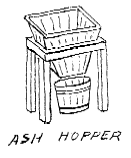
Some colonists used an ash hopper for the making of lye instead of
the barrel method. The ash hopper, was kept in a shed to protect
the ashes from being leached unintentionally by a rain fall. Ashes
were added periodically and water was poured over at intervals to
insure a continuous supply of lye. The lye dripped into a
collecting vessel located beneath the hopper.
The hardest part was in determining if the lye was of the correct
strength, as we have said. In order to learn this, the soap maker
floated either a potato or an egg in the lye. If the object floated
with a specified amount of its surface above the lye solution, the
lye was declared fit for soap making. Most of the colonists felt
that lye of the correct strength would float a potato or an egg
with an area the size of a ninepence (about the size of a modern
quarter) above the surface. To make a weak lye stronger, the
solution could either be boiled down more or the lye solution could
be poured through a new batch of ashes. To make a solution weaker,
water was added.
From Colonial Soap Making: Its History and Techniques -- The Soap
Factory http://www.alcasoft.com/soapfact/history.html
'When a fresh egg floats with a nickel-sized to quarter-sized area
above the surface, the liquor is ready for soap making.' --
Homestead mailing list.
Nickel = 2 cm diameter
Quarter = 2.5 cm diameter
At the turn of the last century lye was obtained by leaching water
through wood ashes. At best, the concentration of potassium
hydroxide in the resulting lye water was always questionable. My
grandmother said that she could tell if the lye water was the right
strength by using the wing feather pulled from her favorite goose.
She would pour the lye water into a 30 gallon cooking pot and heat
the solution. Next she would touch the feather to the heating lye.
If the feather dissolved, the lye was strong enough to dissolve pig
fat.


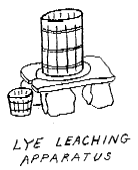 The lye
solution was obtained by placing wood ashes in a bottomless barrel
set on a stone slab with a groove and a lip carved in it. The stone
in turn rested on a pile of rocks. To prevent the ashes from
getting in the solution a layer of straw and small sticks was
placed in the barrel then the ashes were put on top. The lye was
produced by slowly pouring water over the ashes until a brownish
liquid oozed out the bottom of the barrel. This solution of potash
lye was collected by allowing it to flow into the groove around the
stone slab and drip down into a clay vessel at the lip of the
groove.
The lye
solution was obtained by placing wood ashes in a bottomless barrel
set on a stone slab with a groove and a lip carved in it. The stone
in turn rested on a pile of rocks. To prevent the ashes from
getting in the solution a layer of straw and small sticks was
placed in the barrel then the ashes were put on top. The lye was
produced by slowly pouring water over the ashes until a brownish
liquid oozed out the bottom of the barrel. This solution of potash
lye was collected by allowing it to flow into the groove around the
stone slab and drip down into a clay vessel at the lip of the
groove.