and Mercy Corps to develop a benefit plan that ensures real time
payouts once a pre-defined set of criteria are met. Unfortunately,
the
press release makes the misleading statement
that, 'Cholera first appeared in Haiti after the heavy rains in the
fall of 2010.'
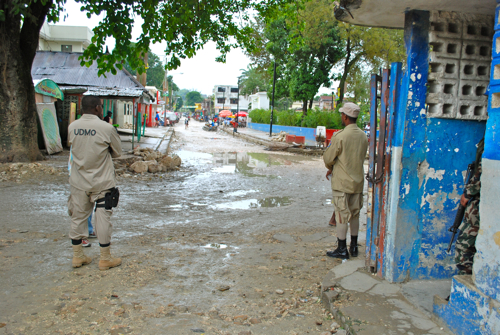 Mirebalais: The epicenter of the 2010 cholera outbreak
in Haiti Photo: G. Nienaber
Mirebalais: The epicenter of the 2010 cholera outbreak
in Haiti Photo: G. Nienaber
But the minutiae of this story goes beyond 'heavy rains' and the
offer of cholera insurance. It is a narrative that crosses into the
grey existential realms of morality. It requires an examination of
duty, individual rights, guilt and reparation. The players are
neither good nor bad, but the Haitian people will bear the
consequences of decisions made in the halls of financial
power.
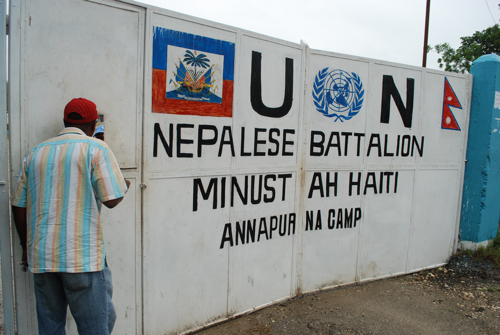
Despite Swiss Re's brief statement that cholera appeared after
heavy October rains,
reports by the Centers for Disease Control, the
United Nations and
others confirm that United Nations' troops
from Nepal contaminated the Artibonite River system because of a
faulty septic system that pumped sewage contaminated with the
bacterium Vibrio cholera directly into the Meille River near the
central plateau city of Mirebalais.
Notwithstanding initial United Nations denials and CDC
affirmations, the contagion quickly spread through the fertile
Artibonite valley and the local prison, On October 14, 2011 the
cumulative
number of reported cholera cases was 473,649,
of which 251,885 (53%) were hospitalized and 6,631 persons had
died.
On the surface, 'cholera insurance' appears prudent until one asks
a few important questions. Critics ask why Haitians should pay for
cholera insurance when the United Nations has yet to make
reparations for a disease it introduced to a country that had never
before experienced this strain of cholera and no other cholera
infections for over a century. Cholera is entirely preventable and
treatable, but treatment must be swift and aggressive. Why are
there no plans by either the Clinton Global Initiative or
organizations that benefit from its funding to either fix the water
delivery system once and for all, provide water filtrations systems
in remote areas, and/or place permanent cholera treatment centers
in every village in Haiti? Former president Bill Clinton is also
the United Nations Special Envoy to Haiti.
Regine Barjon, President, BioTek Solutions,
Inc./Biotek Haiti S.A., recently provided testimony at a joint
hearing of the Western Hemisphere and International Development
Subcommittees of the Senate Foreign Relations Committee. Regarding
the advisability of cholera insurance, Barjon, in an email,
expressed the need for infrastructure as a priority.
We must first acknowledge that the main causes of
cholera is the lack of access to potable water for most Haitians
and the inability of the State to provide adequate waste collection
services, which it cannot afford due in part to an insufficient tax
pool. Though I strongly believe that addressing cholera is the
right and human thing to do, I am hoping that we can start looking
beyond mere containment towards establishing the necessary
foundation that will prevent future outbreaks and reduce the
Haitian population's vulnerability to any such
illnesses.
Fonkoze is
Haiti's largest micro finance organization. Founded in 1994 as
Fondasyon Kole Zépol by Father Joseph Philippe, the
Grameen Foundation recipient currently has 50,533
women borrowers with an outstanding loan balance of 409,376,655
(HTG Haitian Gourdes) or US $10,021,257. The Grameen Foundation has
been supporting microfinance activities in Haiti since 2003.
Grameen gives Fonkoze
high marks and positive assessments for its work in
Haiti.
Swiss Re is also partnered with Fonkoze in a natural catastrophe
micro insurance program that provides protection to women clients
against work losses due to earthquakes, floods and hurricanes. The
policy paid out following very heavy rains in late May and early
June 2011 in the southwest part of Haiti. A total of 3,815 clients
received insurance benefits, according to James Kurz, Fonkoze's
senior financial analyst.
Kurz explained in an email that the price of the current
work
loss policy is 3% of the value of the client's loan. 'They pay
the premium at the time of the disbursement. So for example, a
client taking a $250 loan would pay $7.50 when they receive their
loan.'
The current policy does not include
cholera insurance,
which is still under development. 'The commitment that the partners
made at CGI was to develop a cholera product, test it, roll it out
with Fonkoze's clients, and then share the results with the world,'
Kurz says. That means that it is very early. We don't know exactly
how the product will work, or what the price will be.'
Kurz confirmed that obtaining work loss insurance is a
pre-condition for receiving a loan from Fonkoze. Since there is no
current cholera insurance available, the only model is the current
insurance program for earthquakes, floods and hurricanes. As
a'reinsurer,' Swiss Re is second in the world with over 30 billion
dollars in assets.
Insurance is a
profit driven business and designing a
reinsurance program for micro insurance incorporates standard
business principles, even though micro insurance vendors may
operate in undeveloped or natural disaster areas.
Fonkoze did not want to comment on the issue of UN reparations, but
Kurz offered that Fonkoze is working in the context of what is
happening today. 'The reality is that the Haitian people are at
risk of cholera. Even if they survive, the disease can cause them
tremendous financial hardship and strip them of years' worth of
hard work getting out of poverty,' he says.
Critics ask whether cholera has introduced a profit motive for
international reinsurers.
Controversial American investment guru
Warren Buffett bailed out Swiss Re in 2009 for 3
billion Swiss francs ($2.6 billion). At the same time, Buffett
invested $5 billion in Goldman Sachs and $3 billion in General
Electric, receiving lucrative terms in both cases, according to
financial analysis published in the New York Times, The Wall Street
Journal and other financial publications.
Buffett has been in the news lately because of the equally
controversial '
Buffett rule.' President Barack Obama coined
the term as part of his deficit reduction plan to raise taxes on
wealthy Americans.
At the time of the bailout, Buffett's holding company, Berkshire
Hathaway, already had significant business ties with Swiss Re. 'In
January 2008, it entered a quota share arrangement with Swiss Re
through which it acquired 20 percent of its new and renewed
property and casualty business in exchange and acquired 3 percent
of its shares at the same time,' according to the
New York Times.
Recently the
Wall Street Journal quoted Buffett's remarks
in his annual letter to Berkshire shareholders in February 2011.
Buffett called 'unwelcome' the repayments of crisis-era investments
he made in GE, Goldman Sachs, and Swiss Re.
WSJ says Buffet's Swiss Re investment 'padded Buffett's wallet by
roughly $1 billion.'
Buffett's letter to investors can be found on
the Internet.
Grousing about the early payback of lucrative loans from Swiss Re,
among others, Buffett wrote to shareholders at Berkshire Hathaway
'all of the redemptions are nevertheless unwelcome.' Worrying that
repayments and reduced earning power due to low interest rates,
Buffett was optimistic about 'getting lucky and finding an
opportunity to use some of our cash hoard at decent returns.'
Writing, 'That day can't come too soon for me,' Buffett 'updated
Aesop,' quipping 'a girl in a convertible is worth five in the
phone book.' (Page 18, second paragraph, last sentence)
Are Fonkoze and Mercy Corps unwittingly helping major stockholders
in the reinsurance firm Swiss Re t


