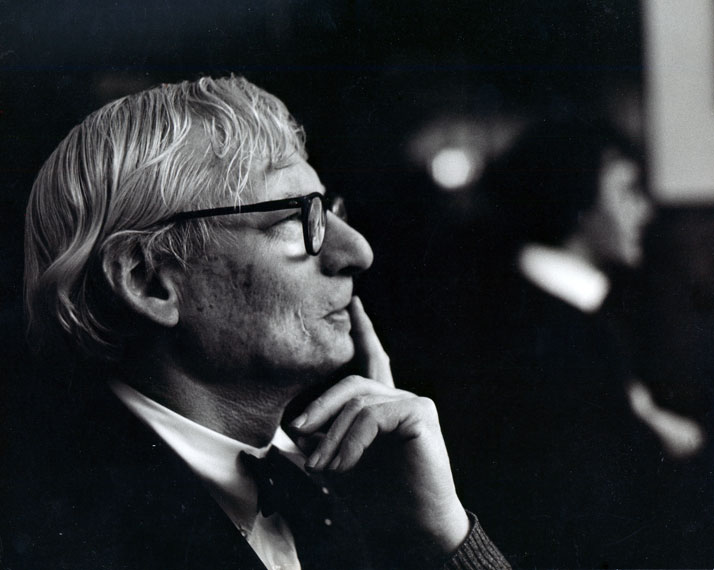
EN A BRICK WANTS TO BE SOMETHING''
whilst(同时) giving an
architecture(建筑学) lecture. Today,
twenty years later, the ''
Louis
Kahn-The Power of Architecture'' exhibition
has just given me the chance to discover more about the
complex(复合体) and
nomadic(游牧的) life of the real man who talked to
this Brick.
''If you think of Brick, you say to
Brick, ‘What do you want, Brick?’ And Brick says
to you, ‘I like an
Arch(弓形).’ And if you say to Brick, ‘Look, arches
are expensive, and I can use a
concrete(混凝土的)
lintel(过梁)
over you. What do you think of that, Brick?’
Brick says, ‘I like an Arch.’ And it’s
important, you see, that you honor the material that you
use. [..] You can only do it if you honor the brick and
glorify(赞美)
the brick instead of
shortchanging(欺骗) it.''
Louis Kahn.
Transcribed(转录) from the 2003
documentary(记录的) 'My Architect: A Son’s
Journey by Nathaniel Kahn'. Master class at Penn,
1971.
 Louis Kahn working on Fisher House
design, 1961.
Louis Kahn working on Fisher House
design, 1961.
© Louis I. Kahn Collection, University of Pennsylvania and the
Pennsylvania Historical and Museum Commission.
The most important projects of the American
architect(建筑师) Louis
Kahn are
extensively(广阔地) documented in the
''
Louis Kahn-The Power of
Architecture(建筑学)'' exhibition which runs
until the
11th of August
2013 at
the
Vitra Design Museum in
Weil am Rhein,
Germany. In
unfolding
Kahn’s
architectural(建筑学的)oeuvre(全部作品)
through a
selection(选择) of
watercolours(水彩画),
pastels(粉蜡笔) and
charcoal(木炭) drawings created during his travels
in Italy, Greece and Egypt to name a few, one thing becomes
apparent(显然的). His skill, not only as an architect but also as
an artist and
illustrator(插图画家).
The exhibition
showcases(陈列橱) Kahn’sdiverse(不同的) range of architecture and
photographs of his beautiful spatial(空间的) compositions and buildings which
display powerful universal(普遍的) symbolism(象征).
Highlights(加亮区) include a four-meter-high model of
the
Philadelphia’s City Tower
(1952-57),
as well as the previously unreleased film shot by
Louis Kahn's son
Nathanial, who was
only 11 years old when his father died.
 Louis Kahn in front of a model of the
City Tower Project in an exhibition at Cornell University, Ithaca,
New York, February 1958.
Louis Kahn in front of a model of the
City Tower Project in an exhibition at Cornell University, Ithaca,
New York, February 1958.
© Sue Ann Kahn.
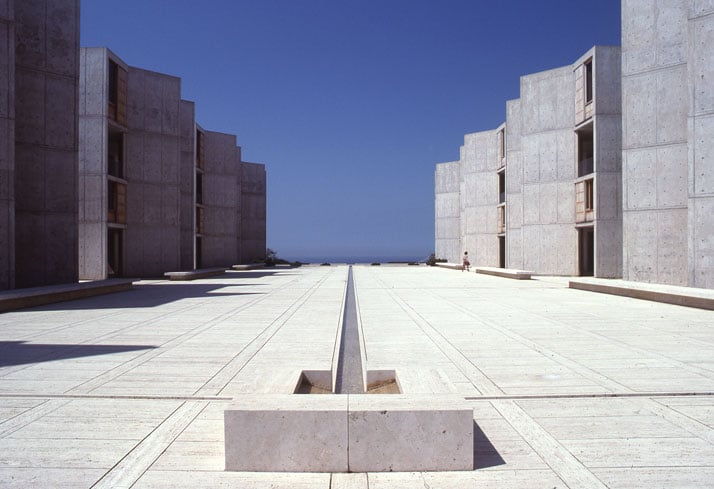 Salk Institute in La Jolla, California,
Louis Kahn, 1959–65.
Salk Institute in La Jolla, California,
Louis Kahn, 1959–65.
© The Architectural Archives, University of Pennsylvania, photo:
John Nicolais.
 Louis I. Kahn and Nathaniel
Kahn, ca.1970.
Louis I. Kahn and Nathaniel
Kahn, ca.1970.
Photo by Harriet Pattison, © 2003 Louis Kahn Project,
Inc.
 National Assembly Building in Dhaka,
Bangladesh(孟加拉国), Louis Kahn, 1962–83
National Assembly Building in Dhaka,
Bangladesh(孟加拉国), Louis Kahn, 1962–83
Directed by
Nathanial
Kahn, and co-produced with
Susan Rose Behr,
the film ‘
My Architect: A Son’s Journey’
(2003), unveils
Nathaniel Kahn’s
attempt to learn more about his father’s
complex(复杂的) life using
the
haunting(不易忘怀的),
monumental(不朽的) creations(创造) as
the
medium(方法) with which to discover the man who
designed them. This is
a journey of love, art,
betrayal(背叛) and forgiveness(宽恕), especially when you realise how
rife(普遍的) this man’s life was with secrets and
chaos(混沌). His marriage to a woman (
Esther
Israeli), the daughter they had, his long-term
relationship with an
architect(建筑师) (
Anne Tyng), with
whom he had another daughter and then a long-term relationship with
the
landscape(风景) architect (
Harriet
Pattison), who is your mother;
add to this the
fact that the members of this
complicated(难懂的) trio(三重唱) didn't meet until Kahn's funeral,
and you
have all the elements(基础) of
a script for the perfect drama(戏剧) -
which is based on a true story!Thankfully however, with a
happy end, as
Nathanial
in the film, finds
the answers he's been searching for hidden
inside
Kahn's
magnum(大酒瓶) opus(作品) ''
Jatiyo Sangshad Bhaban,
the National Assembly Building'' in
Dhaka,
Bangladesh
(1962).
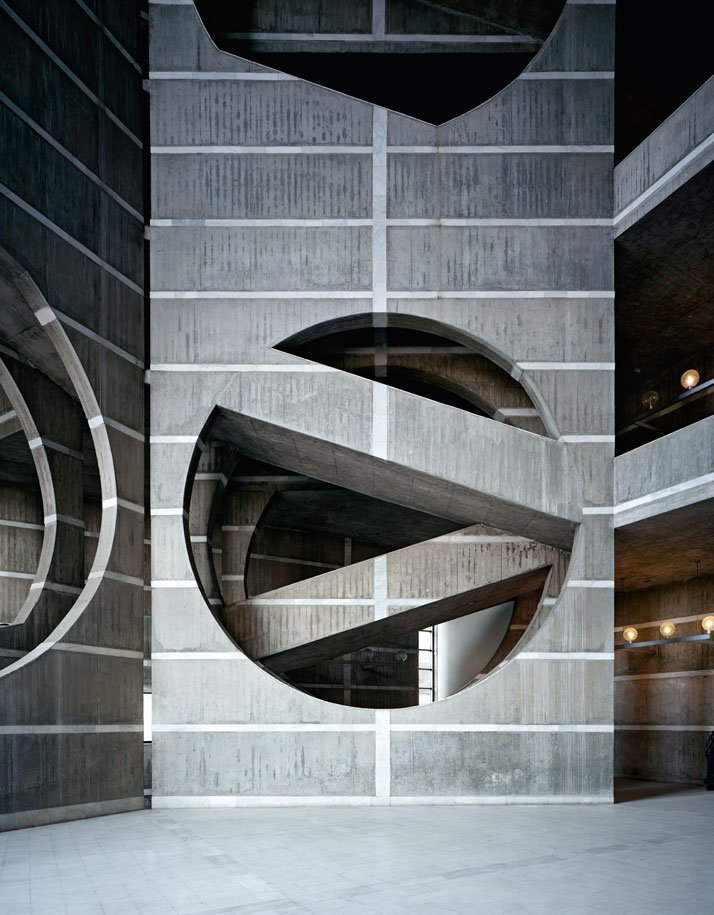 National Assembly Building in Dhaka,
Bangladesh(孟加拉国), Louis Kahn, 1962–83
National Assembly Building in Dhaka,
Bangladesh(孟加拉国), Louis Kahn, 1962–83
© Raymond Meier.
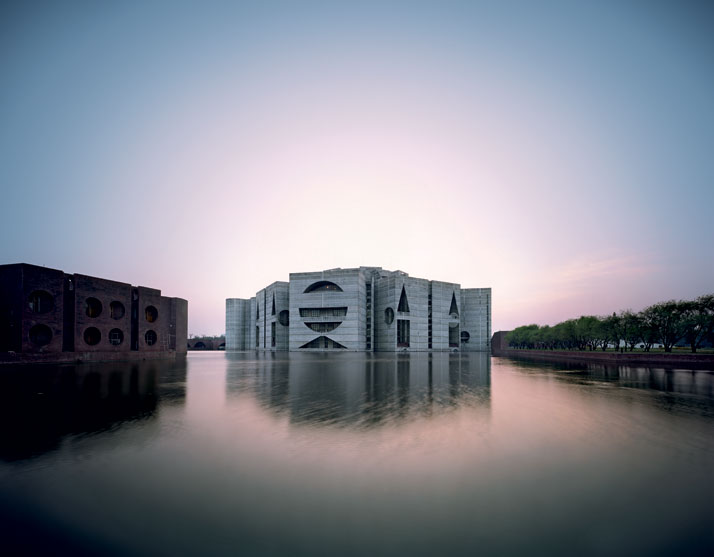 National Assembly Building in Dhaka,
Bangladesh, Louis Kahn, 1962–83.
National Assembly Building in Dhaka,
Bangladesh, Louis Kahn, 1962–83.
© Raymond Meier.
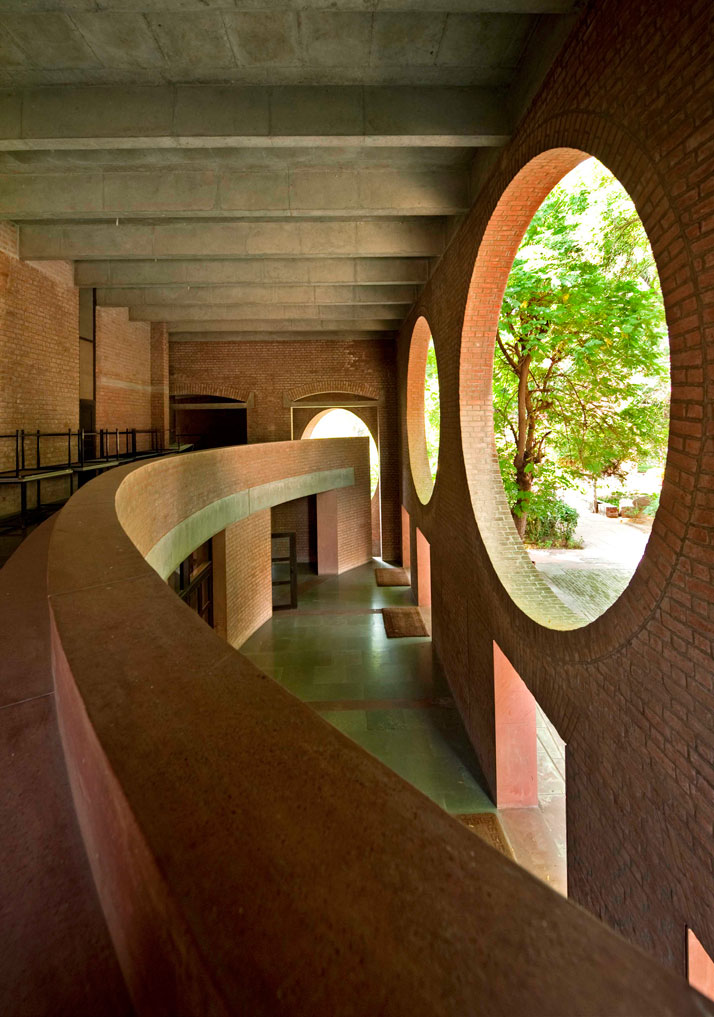 Indian Institute of Management,
Ahmedabad.
Indian Institute of Management,
Ahmedabad.
 Indian Institute of Management,
Ahmedabad.
Indian Institute of Management,
Ahmedabad.
© Alessandro Vassella, 1970.
Whilst Nathanial Kahn
brings a degree of light upon his own
'family's issues', the element(元素) ofLIGHT
itself was always his father’s
obsession(痴迷). It was the
protagonist(主角) of his designs, both inside and
outside his buildings and danced across the walls he built,
changing
continuously(连续不断地) throughout the course of the day.
Unlike other
architects(建筑师), his
palette(调色板) of materials
leaned(倾斜) heavily towards
textured(有织纹的)BRICK
and
bare(空的) concrete(具体物) with astonishing
facility(设施), creating spaces both highly
functional(功能的)and spiritually
uplifting(令人振奋的).
In 1904, at the age of three, Kahn suffered severe(严峻的) burns to his face and hands marking
him for life. Who would have ever thought then that his
preferred drawing material would have been
charcoal
with which
he
sketched(画素描或速写)
''objects'' that
went on to become some of the most important buildings of the 20th
century during the final two
decades(十年) of his life. Some of these
masterpieces(杰作) include; The
Salk Institute for
Biological Studies in La Jolla, California (1959); the
''
Jatiyo Sangshad Bhaban, the National Assembly
Building'' of
Bangladesh(孟加拉国) in Dhaka, Bangladesh (1962); the
Phillips
Exeter Academy Library in New Hampshire (1965), the
Kimbell Art
Museum in
Fort Worth, Texas (1966), and the
massive(大量的) granite-block
memorial to American
President Franklin D. Roosevelt (designed 1973-74) on the tip of
Roosevelt Island in New York’s East River, which was
posthumously(死后的) completed in October 2012.
 FDR Four Freedoms Park
(designed 1973-74) on the
tip of Roosevelt Island in New York’s East River. Completed
in October 2012.
FDR Four Freedoms Park
(designed 1973-74) on the
tip of Roosevelt Island in New York’s East River. Completed
in October 2012.
© 2013 Franklin D. Roosevelt Four Freedoms
Park.
'I had this thought that a memorial
should be a room and a garden. That's all I had. Why did I want a
room and a garden? I just chose it to be the point of departure.
The garden is somehow a personal nature, a personal kind of control
of nature. And the room was the beginning
of architecture(建筑学). I had this sense, you see, and the room
wasn't just architecture, but was an
extension(延长) of self.'
Louis Kahn,
transcript(成绩单) from a lecture at the Pratt
Institute in 1973.
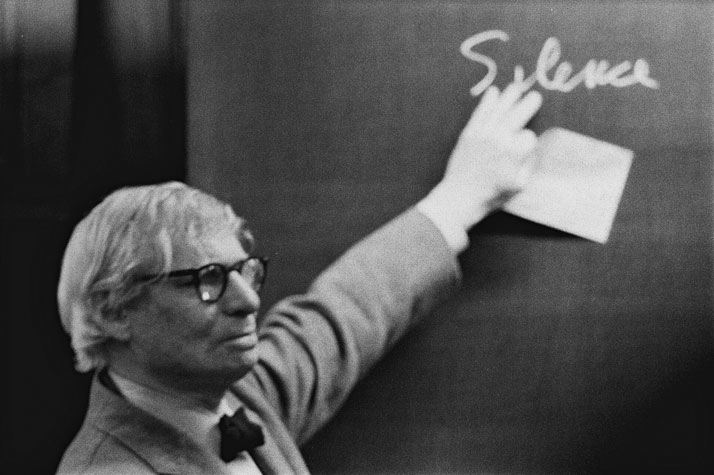 Louis I. Kahn during the lecture at the
ETH Zurich.
Louis I. Kahn during the lecture at the
ETH Zurich.
Photo by Peter Wenger © Archives de la construction moderne – Acm,
EPF Lausanne.
 The cover of the book ''Louis I. Kahn-
Silence and Light'', © Park Books.
The cover of the book ''Louis I. Kahn-
Silence and Light'', © Park Books.
In 1974, Kahn died of a heart attack in a men's
restroom(厕所) in Pennsylvania Station in New York.
He went
unidentified(未经确认的)
for three days
because he had crossed out the home address on his passport. He had
just returned from a work trip to India.
Despite(尽管) his long
career(事业), he was deep in debt when he died. So in
answering the question ''
Can you get to know someone after
his death?'' the answer lies in the recent interest that
Kahn
has
piqued(赌气的). Asides from the exhibition at the Vitra Design
Museum,
Kahn and his
legacy(遗赠) live on through a recent publication
and soon to be released opera:
>>
His lecture ''
SILENCE AND
LIGHT'' which he gave on February 12,
1969 at the School of Architecture at the Swiss Federal Institute
of Technology in Zürich is also the title of a book recently
published by
PARK BOOKS, edited
by
Alessandro Vassella and forwarded by Indian
architect(建筑师) Balkrishna V.
Doshi. The lecture is represented
in
transcripts(成绩单)
in five different
languages - German, Italian, English, French, and Spanish - as well
as
a 60
minute audio recording of
Kahn
giving the lecture in English included
on a CD, gives us an
opportunity(时机) to discover the man’s spiritual
understanding of
architecture(建筑学), which goes far deeper than simply constructing
buildings.
>>
Entitled ''
ARCHITECT'', the opera
composed(构成) by Pulitzer Prize-winner
Lewis
Spratlan with
librettist(歌词作者)
and
electro(电镀物品) acoustic(原声乐器) composers
Jenny Kallick
and
John
Downey, is an
instrumental(乐器的) and
vocal(歌唱的) music
blend(混合) drawn from acoustic recordings
within Kahn's buildings.
Unveiling(使公诸于众) the relationship between sound and
space, and the connection between the past and
present,
Kahn’s work and his
assertion(断言) that '
TO HEAR A SOUND IS TO SEE A
SPACE'', are brought back to life. The opera
is expected to be released at the end of July 2013 by
Navona Records.
***
Louis Kahn: The Power of Architecture is on show at the Vitra
Museum until August 2013. Its next stop will be the London Design
Museum in 2014.
 ARCHITECT by
Navona
Records.
(Featuring(起重要作用)
a
watercolor(水彩画) artwork by
Michiko Theurer
on the cover)
ARCHITECT by
Navona
Records.
(Featuring(起重要作用)
a
watercolor(水彩画) artwork by
Michiko Theurer
on the cover)
 Louis Kahn at the
auditorium(礼堂) of the Kimbell Art Museum,
1972.
Louis Kahn at the
auditorium(礼堂) of the Kimbell Art Museum,
1972.
© Kimbell Art Museum, photo: Bob Wharton.
 Colonnade(柱廊) on the north side, Kimbell
Art Museum, Fort Worth, Texas, Louis Kahn, 1966–1972.
Colonnade(柱廊) on the north side, Kimbell
Art Museum, Fort Worth, Texas, Louis Kahn, 1966–1972.
© 2010 Kimbell Art Museum, Fort Worth, photo: Robert
LaPrelle.
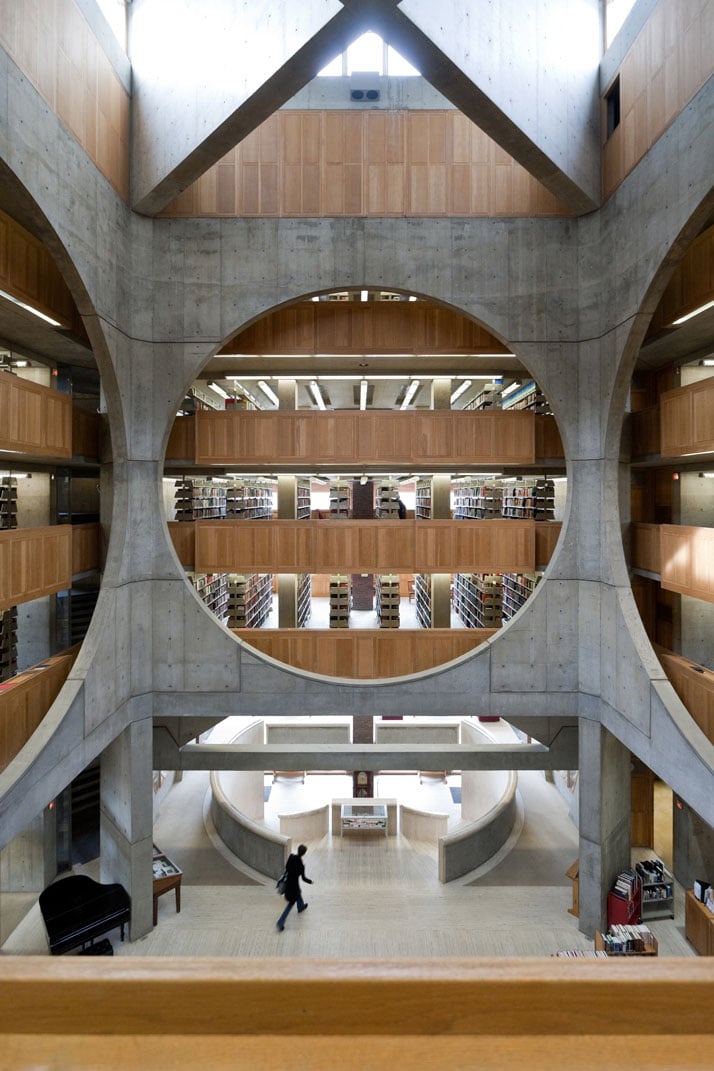 Library, Phillips Exeter Academy,
Exeter, New Hampshire, Louis Kahn, 1965–72.
Library, Phillips Exeter Academy,
Exeter, New Hampshire, Louis Kahn, 1965–72.
© Iwan Baan.
 Ponte Vecchio, Florence, Italy, Louis
Kahn, c. 1930.
Ponte Vecchio, Florence, Italy, Louis
Kahn, c. 1930.
© Private Collection, photo: Paul Takeuchi
2012.
 Steven and Toby Korman House, Fort
Washington, Pennsylvania, Louis Kahn, 1971–73.
Steven and Toby Korman House, Fort
Washington, Pennsylvania, Louis Kahn, 1971–73.
© Barry Halkin.
 Living-room of the Norman and Doris
Fisher House, Hatboro, Pennsylvania, Louis Kahn, 1960–67.
Living-room of the Norman and Doris
Fisher House, Hatboro, Pennsylvania, Louis Kahn, 1960–67.
© Grant Mudford.
 Jewish Community Center, Ewing Township
(near Trenton), New Jersey, Louis Kahn, 1954–59. Exterior view of
the Bath House with a wall drawing at the entrance designed by
Kahn.
Jewish Community Center, Ewing Township
(near Trenton), New Jersey, Louis Kahn, 1954–59. Exterior view of
the Bath House with a wall drawing at the entrance designed by
Kahn.
© Louis I. Kahn Collection, University of Pennsylvania and the
Pennsylvania Historical and Museum Commission, photo: John
Ebstel.
 Alfred Newton Richards Medical Research
and Biology Building, Philadelphia, Pennsylvania, Lousi Kahn,
1957–65.
Alfred Newton Richards Medical Research
and Biology Building, Philadelphia, Pennsylvania, Lousi Kahn,
1957–65.
© The Architectural Archives, University of Pennsylvania, photo:
Malcolm Smith.