D-Cubed组件
2011-03-24 15:00阅读:
CAD、CAM、CAE及PLM应用软件的组件软件

D-Cubed组件是
六个软件库,可由软件开发商许可集成到自己的产品中。D-Cubed组件为CAD、CAE、CAM、PLM应用程序提供关键的功能,包括
二维/三维参数化草图绘制、三维零件和装配建模、运动仿真、碰撞检测、间隙测量以及(隐藏线)可视化。
作为PLM组件产品族的一部分,Siemens PLM
Software不仅开发了这些组件,在自己的所有应用软件中使用这些组件,而且还把这些组件许可给独立的软件提供商和终端用户组织,让其把这些组件集成到他们自己的应用软件中。通过灵活的许可证组织以及一个简单的、经过证明的集成过程,任何组织,无论大小,都能够快速、经济地增强自己的应用软件。为了支持使用这些组件,Siemens
PLM Software还提供了广泛的服务。
D-Cubed组件是可以提高应用软件在CAD、CAM、CAE以及PLM市场的盈利能力的软件工具,提高应用软件的价值并降低其成本。通过用经过证明的工具进行创新,提高竞争力,确保质量并缩短上市时间,就可以实现这一目标。
D-Cubed组件已被全球大量软件厂商采用,应用领域包括机械CAD、CAM、CAE、注塑模设计、钣金、AEC、GIS、结构、工厂以及船舶设计、CMM、逆向工程以及销售配置。
D-Cubed: Latest release of the PGM, Version
4.0
Released February 2006
D-Cubed announces the latest release of its Profile Geometry
Manager (PGM), the component that adds new productivity tools to 2D
DCM-based sketchers. New functionality specific to version 49.0 is
listed below.
More flexibility when editing base and offset loops
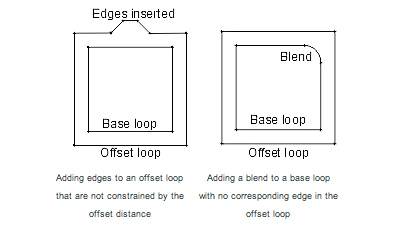
The PGM enables the easy creation and modification of offset loops.
The PGM was previously designed to operate in situations where
edges in a base loop would have corresponding edges in an offset
loop, each pair having the same offset distance. Version 49.0
supports offset profile modifications that no longer have to
satisfy these conditions. Examples include inserting edges in an
offset loop that are not constrained by the offset distance, and
inserting edges in a base loop with no corresponding edges in the
offset loop, as illustrated below.
The new functionality gives applications much more flexibility,
enabling specific, local changes to base and offset loops whilst
preserving the offset relationship elsewhere in the loop.
Enhanced support for modelling operations in PGM based
applications
The PGM automatically trims intersecting edges in an offset loop in
order to provide results that are productive for the designer.
During this trimming process, an offset loop can be divided into
various subloops. It is important for various modelling operations
to track the creation and deletion of such subloops
For example, consider the profile below in which two subloops have
been created as a result of trimming the intersecting edges in an
offset loop:
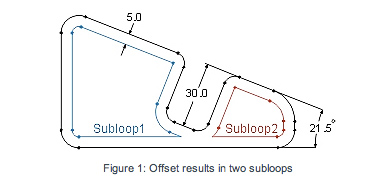
Version 49.0 enables the application to keep track of these
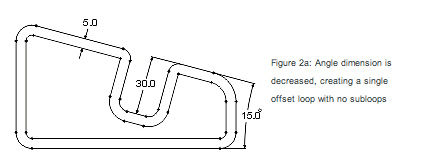
subloops by assigning persistent identifiers to each of them. For
example, in figure 2a below, the angle dimension is modified such
that the offset loop no longer self-intersects and there are no
subloops:
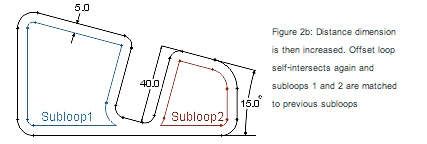
In figure 2b, the distance dimension of 30 units is then increased
to 40 units and the offset loop once again self-intersects,
creating two subloops. The PGM associates the subloops in the new
configuration with the subloops in the original configuration in
figure 1 using persistent identifiers.
Enabling subloops to persist from one configuration to the next
satisfies a critical requirement for certain applications to keep
track of such features.
Development Environment Support
D-Cubed uses the new technologies released in Microsoft Visual
Studio® 2005. In particular, the 64-bit Windows® platform is now
fully supported, using the X64 compilers released with Visual
Studio 2005, enabling advanced applications to utilise the D-Cubed
components with very large data sets to achieve unparalleled
performance and scalability.
As part of our ongoing commitment to deliver the highest quality
software components and service to our customers developing on a
wide range of software and hardware platforms, D Cubed also
supports the latest Apple Mac OS X 10.4 known commonly as OS X
Tiger.
Note: change to version numbering scheme
New releases of the PGM and 2D DCM are made simultaneously. This
enables D-Cubed to verify that both components from a given
development cycle interoperate correctly. To simplify the process
of identifying components from the same release cycle, the same
version number is now assigned to all of the components at release
time. For this reason, please note that the version number for both
the PGM and 2D DCM components has been set to 49.0.
About the PGM
The Profile Geometry Manager (PGM) enhances the productivity of 2D
DCM based applications, enabling a range of advanced variational
sketching operations that are not available in any other system.
This is achieved by working directly with higher level geometric
data structures and automatically handling a wide range of design
changes. Examples including offsetting open or closed loops whilst
inserting, extending and trimming edges as required, or adding
constraints to open or closed loops rather than to individual
edges.
D-Cubed
D-Cubed software is part of the PLM Components suite of solutions
and represents a family of geometric software components that
enable key functionality in CAD, CAM, CAE, and PLM applications,
including sketching, part and assembly modeling, motion simulation,
collision detection, clearance measurement and hidden-line
visualization.
http://blog.sina.cn/dpool/blog/s/blog_616aad090101bg5y.html?vt=4

