We tend to think of the decades immediately following World War II
as a time of exuberance and growth, with soldiers returning home by
the millions, going off to college on the G.I. Bill and lining up
at the marriage bureaus.
But when it came to their houses, it was a time of common sense and
a belief that less truly could be more. During the Depression and
the war, Americans had learned to live with less, and that
restraint, in combination with the postwar confidence in the
future, made small, efficient housing positively stylish.
As we find ourselves in an era of diminishing resources, could
“less” become “more” again? If so, the mid-20th-century building
boom might provide some inspiration.
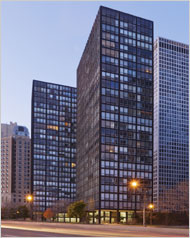 William
Zbaren Ludwig Mies van der Rohe designed these towers
on Chicago’s Lake Shore Drive in the 1940s. They were recently
renovated.
William
Zbaren Ludwig Mies van der Rohe designed these towers
on Chicago’s Lake Shore Drive in the 1940s. They were recently
renovated.
Economic austerity was only one of the catalysts for the trend
toward efficient living. The phrase “less is more” was actually
first popularized by a German, the architect Ludwig Mies van der
Rohe, who like other people associated with the Bauhaus emigrated
to the United States before World War II and took up posts at
American architecture schools. These designers, including Walter
Gropius and Marcel Breuer, came to exert enormous influence on the
course of American architecture, but none more so than Mies.
Mies’s signature phrase means that less decoration, properly
deployed, has more impact than a lot. Elegance, he believed, did
not derive from abundance. Like other modern architects, he
employed metal, glass and laminated wood — materials that we take
for granted today but that in the 1940s symbolized the future.
Mies’s sophisticated presentation masked the fact that the spaces
he designed were small and efficient, rather than big and often
empty.
The apartments in the elegant towers Mies built on Chicago’s Lake
Shore Drive, for example, were smaller — two-bedroom units under
1,000 square feet — than those in their older neighbors along the
city’s Gold Coast. But they were popular because of their airy
glass walls, the views they afforded and the elegance of the
buildings’ details and proportions, the architectural equivalent of
the abstract art so popular at the time.
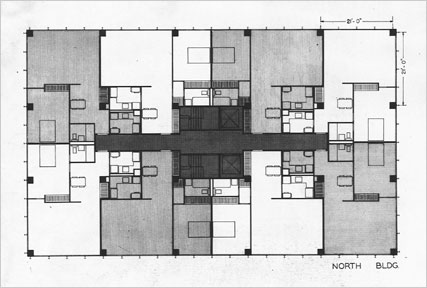 Museum
of Modern Art. Mies van der Rohe Archive, gift of the
architect A Ludwig Mies van der Rohe floor plan for a
860/880 Lake Shore Drive apartment building in Chicago,
1951.
Museum
of Modern Art. Mies van der Rohe Archive, gift of the
architect A Ludwig Mies van der Rohe floor plan for a
860/880 Lake Shore Drive apartment building in Chicago,
1951.
Tom Wolfe’s “From Bauhaus to Our House” aside, the trend toward
“less” was not entirely foreign. In the 1930s Frank Lloyd Wright
started building
more modest and efficient houses — usually around 1,200
square feet — than the sprawling two-story ones he had designed in
the 1890s and the early 20th century.
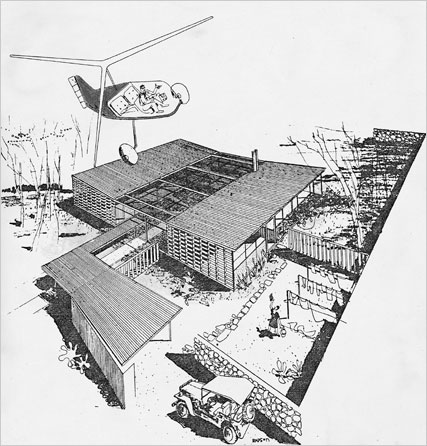 Rapson
Architects Drawing of a “Case Study House” by Ralph
Rapson.
Rapson
Architects Drawing of a “Case Study House” by Ralph
Rapson.
Even the consciously trend-setting Museum of Modern Art promoted
restraint in the early postwar years. In 1945, it held an
exhibition entitled “Tomorrow’s Small House: Models and Plans,” and
the pioneering model houses that Marcel Breuer and Gregory Ain
erected in the museum garden were small and sparsely
detailed.
The “Case Study Houses” commissioned from talented modern
architects by California Arts & Architecture magazine between
1945 and 1962 were yet another homegrown influence on the “less is
more” trend. Aesthetic effect came from the landscape, new
materials and forthright detailing. In his Case Study House, Ralph
Rapson may have mispredicted just how the mechanical revolution
would impact everyday life — few American families acquired
helicopters, though most eventually got clothes dryers — but his
belief that self-sufficiency was both desirable and inevitable was
widely shared.
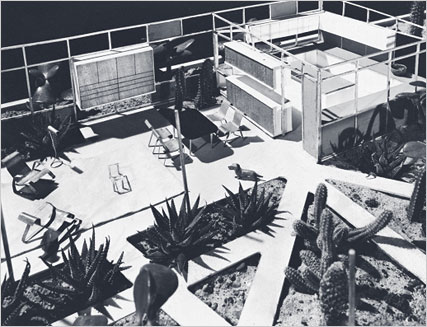 Rapson
Architects Model of the interior of a Ralph Rapson
“Case Study Home.”
Rapson
Architects Model of the interior of a Ralph Rapson
“Case Study Home.”
“Less is more” wasn’t for everyone; modernism was popular mainly
with the so-called “Progressives,” the professionals and
intellectuals who commissioned modern houses. But these
trend-setters were not alone in assuming there would be fewer
servants in the future and that modern conveniences would make
housework easier to do, especially in smaller quarters.
 Levittown
Public Library, via Associated Press New residents
moved into their home in Levittown, N.Y. in 1947.
Levittown
Public Library, via Associated Press New residents
moved into their home in Levittown, N.Y. in 1947.
The popularity of simpler living made it possible for one American
developer, William Levitt, to realize the prewar dream of the
European modern architects to use industrialization for housing.
During the war, Levitt had become an expert in mass-producing homes
for shipyard workers in Virginia. When it ended, Levitt and his
sons created a prototype 750-square-foot, one-floor house—with a
living room, kitchen/dining area, two small bedrooms, a bathroom
and an unfinished “expansion attic”—to fit on a 60 x 100 foot lot.
Set on concrete slabs like those at the shipyards, the new houses
were built quickly and cheaply on a sort of assembly line, with
pre-cut lumber and nails shipped from the Levitts’ factories in
California.
Eventually, the Levitts built 140,000 houses, clustered in
Levittowns on Long Island and near Philadelphia for some of the 16
million returning veterans. In the 1950s, the houses grew slightly,
to 800 square feet, and came equipped with carports and built-in
12.5-inch Admiral TVs. Clearly no one considered multiple
televisions, or that they would be frequently replaced.
Related
More on design and architecture.
The Levittown houses were concentrated on the East Coast, but they
influenced suburban development throughout the United States,
though elsewhere houses were built manually, as they would be after
the postwar building boom. The standard two-bedroom house with an
expandable attic became the norm for more than a decade, even as
family size mushrooomed.
But like much of American society, the middle-class home began to
grow over time. The average size of an American house in 1950 was
983 square feet. Slowly, though, both more square footage and more
amenities became part of the American dream, so that by 2004 the
average home topped 2,300 square feet.
What does all that space bring? Small, out-of-the-way bedrooms like
those in the Levittown houses’ “expandable attics” can be used when
children are at home or guests arrive, and the open plan of their
main living spaces has become the kitchen/family room that is the
center of the American home today. But many of the “must-have”
elements in 2010, like formal living and dining rooms, are
redundant. In an era of economic austerity and a seemingly
permanent energy crisis, can “less is more” become popular
again?
Sadly, many of the small, architect-designed houses of the postwar
period have been demolished to make way for McMansions. But those
that remain, and those we know about from blueprints and
photographs, have much to teach us — about the efficient use of
space for storage, integrated indoor and outdoor space and the way
careful design can facilitate natural ventilation. When you think
about how many rooms you actually use, it seems obvious that
various ideas from that optimistic era could make the next decade a
happier, saner one than the overstuffed times we’ve just lived
through.
(Note: An earlier version of this article misattributed the
origin of the phrase “less is more” to the architect Ludwig Mies
van der Rohe. He did not coin the phrase, but adopted and
popularized it as an aesthetic maxim.)
 Jayne Merkel is an architectural historian and critic. She is
the author, most recently, of “Eero Saarinen.” She is a
contributing editor of Architectural Design/AD magazine and
Architectural Record.
Jayne Merkel is an architectural historian and critic. She is
the author, most recently, of “Eero Saarinen.” She is a
contributing editor of Architectural Design/AD magazine and
Architectural Record.

 Living
Rooms explores the past, present and future of domestic
life.
Living
Rooms explores the past, present and future of domestic
life.