资金必须有5万美元。如果按照10倍的杠杆计算,你相当于在交易一个50万美元的账户。虽然Emini
SP500已经比原来原始的SP500期货缩小了5倍的最小交易量,但是还是超出了很多普通投资者的风险承受能力。
这也是我们要交易股指期货对应的CFD的原因之一。同时也要提醒大家,有一些经纪商号称有2500美元就能开一个期货交易账户。经纪商没有骗你,只不过这样的小账户是经不住盈亏的波动,特别是新手,这些小账户肯定会爆仓(就是账户资金几乎全部亏损,被交易系统强制平仓),大家不要盲目参与。我建议你没有10万美元不要做期货,而且每次的交易量还是要最小的。你要时刻提醒自己,你不是在操作10万美元,你是在操作100万美元,你盈亏百分比的基数不是10万美元,而是100万美元。比方说,你10万美元的账户,一个月盈利了10万美元,不要觉得不可能,也不要觉得很了不起,因为你不是盈利了100%,而是10%。反过来说,你10万美元的账户,一个月输了10万美元,也不要觉得不可能,也不要觉得这么惨,因为你不是输了100%,而是输了10%。理解了这点,你对期货的回报率/亏损率就会有一个理性的认识。
小结一下,Emini
SP500期货已经比原始的SP500期货的最小交易量缩小了5倍,使得更多的交易者可以参与。但是对于大多数的散户,资金风险还是偏大。而交易股指期货对应的CFD就可以避免这个问题,股指CFD的最小交易量是Emini股指期货的1/100。当然,CFD还有其它特点。因为股指CFD来源于Emini股指期货,
Emini
SP500是Emini股指期货的代表,所以理解Emini SP500对于理解股指CFD的交易是有帮助的。)
*******************************************************************************
What Are Emini Futures and Why Trade
Them?
UPDATED:
FRIDAY 22 JANUARY 2016
Emini S&P 500 futures are probably the most important
trading vehicle in the world.
The Emini (or E-mini or ES) is a futures contract that tracks the
S&P 500 index. It is traded on the
Chicago Mercantile Exchange (CME) via
their Globex electronic platform. Trading is 23 ½ hours a day, 5
days a week, using the ticker symbol ES. Each 1 point move in the
S&P 500 index is worth US$50 per Emini contract and the minimum
move of the Emini futures contract (or tick size) is 0.25 index
points.
Use the links below to jump to a particular section:
Emini futures are the perfect day trading vehicle
Why trade Emini futures? The Emini has a number of advantages for
traders and day traders:
- Equally easy to go Long or Short: You
either buy or sell the current Emini contract and there is no
up-tick rule. If you traded the SPY ETF you would have to buy or
sell different ETFs (Long: SPY or leveraged SSO; Short: SH or
leveraged SDS).
- 24-Hour trading: Which makes the Emini
attractive to traders around the world. Overnight moves in related
equity markets, like the DAX or FTSE, can be played with the one
trading vehicle.
- Electronic trading platform: Your orders
are entered instantaneously and when executed you are notified
instantaneously. Changing and cancelling orders is trivial – no
phone call to your broker required – and you know exactly where you
stand every minute you’re in a trade.
- Level playing field: The Globex electronic
trading platform means that large and small traders have equal
access to the market and trades are executed in the order they are
received. Unlike pit-traded futures, no games can be played.
- Tight bid/ask spreads: So much volume is
traded through the Emini, the difference between the bid and the
ask price is only ever 1 tick or 0.25 index points – the
minimum.
- Large depth of market: Again, the Emini
market is so liquid, there is plenty of volume either side of the
last traded price for large orders to be filled with minimum
slippage (or difference from the last traded price).
- Volatile but not unmanageable: The Emini is
active every day, which gives the day trader plenty of opportunity
to trade. Remember, a “sleepy” market is impossible to day trade.
But the Emini volatility is also manageable – except maybe around
FOMC announcements – and is not driven by individual company news
events.
- Low brokerage rates: Broker commissions for
trading Eminis continue to fall. Interactive
Brokers advertise a rate of $0.85 per contract per side
(as of March 2015). This excludes exchange and clearing fees and
when you factor those in, your “round trip” or “in-and-out”
brokerage commission is closer to $2.00 per trade. TradeStation’s
advertised rate is $1.15 per contract per side, but this
includes use of their excellent
charting platform.
- Low margin requirement: To open a day
trading position with Interactive Brokers you only need margin of
$2,875 per Emini contract. This margin requirement doubles to
$5,750 per contract if you hold the position overnight.
TradeStation offers an even lower margin requirement for Emini day
traders of $1,265 per contract. Remember, these are absolute
minimums – you should be trading with much more capital behind your
positions.
- Low minimum account size requirement: To
open a futures trading account with Interactive Brokers you need to
deposit a minimum of $10,000. The same minimum account opening
deposit for TradeStation is $5,000. But if you are an active stock
trader you will be classified as aPattern Day Trader and need to maintain a
minimum account balance of $25,000.
- Lower tax rate than trading forex or stocks:
Income from trading Emini futures is taxed at a “blended”
rate of 23% (60% capital gains taxed at 15% + 40% income taxed at
35%). Gains from trading stocks or cash forex is taxed at 35%.
These comments apply to US-based traders and remember to always get
your own tax advice.
- No trade-by-trade accounting: Another
advantage of the tax treatment of Emini futures is that the tax
reporting requirements are minimal. In particular, no
trade-by-trade accounting is required, only the net income for the
full year is needed.
- Better than Stocks, Forex, Commodities and Bonds:
Check out this video for more reasons to trade Emini futures
and avoid
individual stocks, forex, commodities and bonds.
Over the years I have traded almost every possible security:
stocks, options, commodities, futures, forex, mutual funds, IPOs,
ETFs, etc. But a few years ago I finally found what I consider to
be the ideal trading vehicle – the S&P 500 Emini futures. I
trade it exclusively now and haven’t looked back since.
Emini futures trading began in September 1997
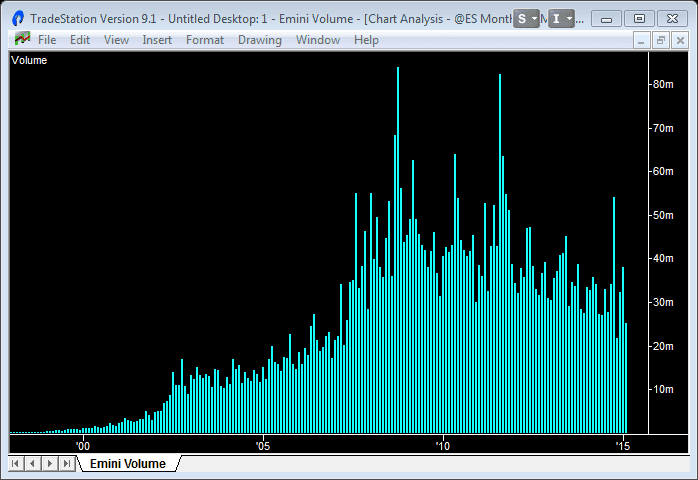
The Emini Has Become Hugely Popular (Emini monthly trading
volume, 1997-2015)
Emini futures were originally launched in September 1997 to attract
non-professional investors into trading index futures. Previously,
the only game in town had been the “large” SP contract – but it had
become too expensive for the “little guy” to trade. So the CME
created the Emini contract which was 1/5th the size of the “large”
S&P 500 futures contract and required 1/5th the margin to
trade.
Over 10 years, the Emini became a huge success. Not only with
non-professionals but with professional traders too. Now everyone
trades the Emini: mutual funds, pension funds, hedge funds,
insurance companies, high frequency trading (HFT) firms, trading
syndicates and individual/non-professional traders.
The chart above shows the growth in monthly Emini trading volumes.
The huge volume spikes of over 80 million contracts traded happened
during large market sell-offs. Average daily trading volume is
regularly over 2 million contracts. Between 2012 and 2015 trading
volumes have backed off, but that decline in trading activity has
been seen across all traded markets.
So that puts the Emini in the Top 3 Largest Traded Markets in the
world. Here are my estimates of the daily capital traded for each
of these markets:
- SPY (S&P 500 Index ETF) = 106 m trades
daily x $200 price = $21 bn in capital
- Euro/US Dollar (Spot Forex) = $78 bn total
Forex market x 24% Euro share = $19 bn in capital
- Emini (ES only) = 1.6 m trades daily x 2
parties x $5 k margin per contract = $16 bn in capital
Note: The SPY ETF is largest but it is more a position taking
market than a day trading vehicle.
The “mini” ES contract has overtaken the “large” SP
contract
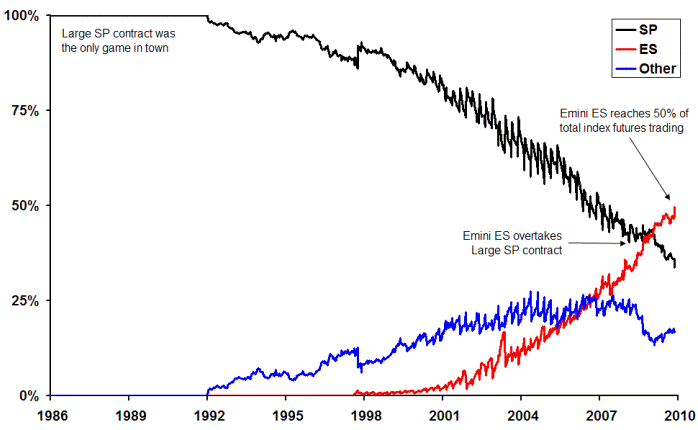
Emini Futures (ES) Overtook the “Large” contract (SP) in
2009
The chart above shows that during 2009 the Emini (ES) overtook the
“large” (SP) contract to become the largest component of the equity
index futures market with just over 50% of total open interest. In
this chart all the contracts have been adjusted for their relative
margin size – so the ES open interest data is divided by 5 so it’s
directly comparable with the SP contract, etc.
The trading volume of the “large” (SP) contract has also collapsed.
It only trades about 0.5 million contracts a month – equivalent to
2.5 million Emini contracts when you adjust for margin
requirements. So less than 10% of the Emini trading volume.
Why?
An interesting switch has taken place since the Emini was
introduced. The
Emini
has become the ‘de-facto’ day trading vehicle of
professionals and the original “large” SP contract has become a
pure position trading and hedging vehicle. This is the exact
opposite of what the CME planned, they thought professionals would
trade the SP and individual traders would be able to hedge with the
Emini. I suppose the many advantages of the Emini were just too
attractive for professional traders to ignore.
The CME has now launched over 40 different “E-mini” and
“E-micro” contracts
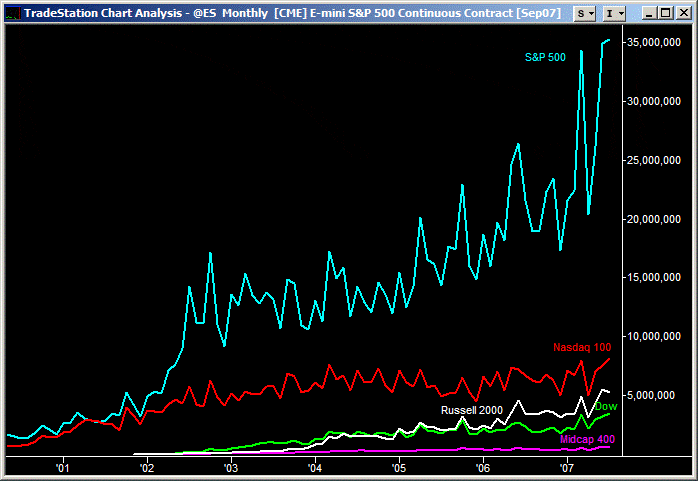
Trading Volume of the Largest Emini Varieties (monthly)
With the success of the S&P 500 Emini the CME (and other
exchanges) decided to launch other “E-mini” and “E-micro” futures
contracts covering additional US indices, metals, commodities and
forex. These other varieties include:
- NASDAQ 100 (symbol NQ, 100 largest NASDAQ companies)
- NASDAQ Composite (symbol QN, all 3,000+ NASDAQ companies)
- NASDAQ Biotech (symbol BQ)
- S&P Midcap 400 (symbol EMD)
- S&P Smallcap 600 (symbol SMC)
- Dow (symbol YM, traded on CBOT exchange)
- Russell 2000 (symbol TF, traded on NYBOT/ICE exchange, small
cap index, formerly ER2 traded on CME)
- Russell 1000 (symbol RF2, traded on NYBOT/ICE exchange, 1,000
largest cap companies, formerly RS traded on CME)
- Metals and commodities such as Copper, Gold, Silver, Corn,
Wheat, Soybeans, Natural Gas, Crude Oil, Heating Oil and Unleaded
Gasoline
- Forex rates versus the US Dollar such as Euro, British Pound,
Swiss Franc, Japanese Yen, Australian Dollar, Canadian Dollar and
Chinese Renminbi
- Options on the S&P 500 Emini and NASDAQ 100 Emini
However, the S&P 500 Emini continues to dominate index futures
as the chart above of monthly trading volumes shows. And of the 40+
“E-mini” and “E-micro” contracts, only 10 have daily trading
volumes over 1,000 contracts. Given these statistics, I wouldn’t be
surprised if the number of “E-mini” and “E-micro” contracts were
rationalised in the future.
On this website – and when traders are talking to each other – the
word Emini generally refers to the S&P 500 Emini futures
contract.
Who trades the Emini? Everyone!
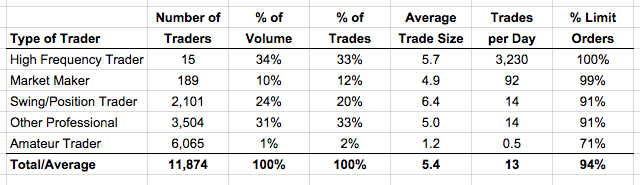
Emini Trading by Trader Type (Average of 3-5 May 2010, Joint
CFTC/SEC Report)
And the chart above shows a breakdown of Emini trading volume by
type of trader. 15 High Frequency Trading (HFT) firms account for
one third of the total Emini market. Almost 6,000 Professional
traders (either day trading or position trading, i.e. holding
overnight) account for the other two thirds of the market. The
6,000 Amateur traders (trading on average 1 contract per trade and
1 trade every other day) account for only 1% of the total Emini
trading volume. (Source:
“Findings Regarding the Market Events of 6 May
2010” Joint Report of CFTC & SEC 30 Sept 2010, page
29)
Update – 42,000 Emini Traders & 30 HFT Firms
Nanex
Resarch published some more data points based on CFTC
data that was used in a Harvard research paper. Between 17
September and 1 November 2010 there were:
- 41,778 Emini trading accounts active
- Including 30 HFT trading accounts, and
- The HFT firms accounted for 46.7% of volume traded
You can
read the full story here.
Emini futures trading hours are almost 24/5
Weekly trading of the Emini opens on Sunday at 5pm (CST) and closes
on Friday at 3:15pm. Trading is almost 24 hours a day with a short
break every day between 3:15pm and 3:30pm and then between 4:15pm
and 5:00pm for any scheduled maintenance.
Trade is broken into two sessions, the Day session and the
After-hours session:
- Day session trading starts at 8:30am (CST) and closes at
3:15pm
- After-hours session trading starts at 3:30pm and continues
until the open of the Day session the next morning
The greatest activity and volume traded obviously happens during
the Day session. However, data releases before the Day session open
can often generate large activity, as can any important news out of
Europe.
The Emini ticker symbol is ES plus codes for expiration month
and year
Emini contracts are very similar to other futures contracts. They
expire quarterly in March, June, September and December and are
denoted by the letters “H”, “M”, “U” and “Z” respectively. So ES11H
(or ESH11) is the ticker symbol for an Emini S&P 500 futures
contract that expires in March of 2011.
Here are the Emini symbols for 2016:
- March 2016 contract: ES16H (or ESH16)
- June 2016 contract: ES16M (or ESM16)
- September 2016 contract: ES16U (or ESU16)
- December 2016 contract: ES16Z (or ESZ16)
To make things easier you can also chart a “continuous” contract on
most charting platforms. Data providers join together (or
concatenate) symbols from adjoining quarters so you can plot a long
history of each contract. In TradeStation, the continuous Emini
futures contract has a symbol of @ES.
Emini contracts rollover and expire every quarter
Contract expiry is on the 3rd Friday of March, June, September and
December. However, contract rollover – when the majority of trading
moves to the next contract – is the far more important date.
Contract rollover is on the 2nd Thursday of March, June, September
and December, unless the rollover month starts on a Friday, in
which case it is on the 1st Thursday of the month.
Here are the Emini futures contract rollover dates for 2016:
- Thursday 10 December 2015: Rollover to the March 2016
contract
- Thursday 10 March 2016: Rollover to the June 2016 contract
- Thursday 9 June 2016: Rollover to the September 2016
contract
- Thursday 8 September 2016: Rollover to the December 2016
contract
- Thursday 8 December 2016: Rollover to the March 2017
contract
Emini futures do “settle” at the end of each quarter, but most
traders have liquidated their positions in the “old” contract and
moved onto the “new” contract. If you happen to be holding an Emini
futures position at settlement time, your trading account is
credited any profit (or debited any loss) on that contract and your
position closed out.
Unlike commodity futures like Copper or Crude Oil, physical
delivery on settlement doesn’t exist for financial futures
contracts like the Emini. Check out this video to understand more
about
Emini
Contract Rollover, Expiry & Continuous Contracts.
Lastly, here’s the Emini futures holiday schedule for 2016
Nothing unusual here. The Emini follows the normal stock market
holidays. Here are the dates for 2016:
- 1 January 2016: New Year’s Day
- 18 January 2016: Martin Luther King Day
- 15 February 2016: President’s Day
- 25 March 2016: Good Friday
- 30 May 2016: Memorial Day
- 4 July 2016: Independence Day
- 5 September 2016: Labor Day
- 24 November 2016: Thanksgiving Day
- 26 December 2016: Christmas Day
- 2 January 2017: New Year’s Day
And you can always find the exact Open and Close times on the
CME Group website here.
And a public calendar with important Emini trading dates
If you use Google Calendar, just hit the “+” button (bottom right
on the calendar below) and it will import this Emini trading
calendar into your personal Google Calendar.
The calendar can also be imported into other calendar applications
using these links:
iCal format and
HTML format. I hope you found this feature
article on S&P500 Emini futures helpful.

