Compactness and compact operator——紧性与紧算子
2013-03-12 11:00阅读:
1.紧集
定义
紧集是拓扑空间内的一类特殊点集,它们的任何开覆盖都有有限子覆盖。在度量空间内,紧集还可以定义为满足以下任一条件的集合:
i)任意列有收敛子列且该子列的极限点属于该集合(自列紧集);
ii)具备Bolzano-Weierstrass性质;
iii)完备且完全有界 。
性质
紧集具有以下性质:
1.点集是紧集的充分必要条件是它为有界闭集。
2.紧集在连续函数下的像仍是紧集。
3.豪斯多夫空间的紧子集是闭集。
4.实数空间的非空紧子集有最大元素和最小元素。
5.Heine-Borel定理:在Rn内,一个集合是紧集当且仅当它是闭集并且有界。
6.定义在紧集上的连续实值函数有界且有最大值和最小值。
7.定义在紧集上的连续实值函数一致连续。
直观理解
从某种意义上,紧集类似于有限集。举最简单的例子而言,在度量空间中,所有的有限集都有最大与最小元素。一般而言,无限集可能不存在最大或最小元素(比如R中的(0,
1)),但R中的非空紧子集都有最大和最小元素。在很多情况下,对有限集成立的证明可以扩展到紧集。一个简单的例子是对以下性质的证明:定义在紧集上的连续实值函数一致连续。
类似概念
自列紧集:每个有界序列都有收敛的子序列。
可数紧集:每个可数的开覆盖都有一个有限的子覆盖。
伪紧:所有的实值连续函数都是有界的。
弱可数紧致:每个无穷子集都有极限点。
在度量空间中,以上概念均等价于紧集。
以下概念通常弱于紧集:
相对紧致:如果一个子空间Y在母空间X中的闭包是紧致的,则称Y是相对紧致于X。
准紧集:若空间X的子空间Y中的所有序列都有一个收敛的子序列,则称Y是X中的准紧集。
局部紧致空间:如果空间中的每个点都有个由紧致邻域组成的局部基,则称这个空间是局部紧致空间。
参考来源:
http://baike.baidu.com/view/1224337.htm
2 相对紧(relatively compact
)
In
mathematics, a
relatively compact subspace (or
relatively compact
subset)
Y of a
topological
space X is a subset whose
closure
is
compact.
Since closed subsets of a compact space are compact, every subset
of a compact space is relatively compact. In the case of a
metric topology,
or more generally when
sequences may be used
to test for compactness, the criterion for relative compactness
becomes that any sequence in
Y has a subsequence convergent
in
X. Such a subset may also be called
relatively
bounded, or
pre-compact, although the latter term is
also used for a
totally bounded
subset. (These are equivalent in a
complete
space.)
Some major theorems characterise relatively compact subsets, in
particular in
function spaces.
An example is the
Arzelà–Ascoli
theorem. Other cases of interest relate to
uniform
integrability, and the concept of
normal family
in
complex
analysis.
Mahler's compactness
theorem in the
geometry of
numbers characterises relatively compact subsets in certain
non-compact
homogeneous
spaces (specifically spaces of
lattices).
The definition of an
almost
periodic function F at a conceptual level has to do with
the translates of
F being a relatively compact set. This
needs to be made precise in terms of the topology used, in a
particular theory.
As a counterexample take any
neighbourhood
of the particular point of an infinite
particular
point space. The neighbourhood itself may be compact but is not
relatively compact because its closure is the whole non-compact
space.
from:
http://en.wikipedia.org/wiki/Relatively_compact
3 紧算子compact operator
In
functional
analysis, a branch of
mathematics, a
compact operator is a
linear operator
L from a
Banach space
X to another Banach space
Y, such that the image
under
L of any bounded subset of
X is a
relatively
compact subset of
Y. Such an operator is necessarily a
bounded
operator, and so continuous.
Any bounded operator
L that has finite
rank
is a compact operator; indeed, the class of compact operators is a
natural generalisation of the class of
finite-rank
operators in an infinite-dimensional setting. When
Y is
a
Hilbert space, it
is true that any compact operator is a limit of finite-rank
operators, so that the class of compact operators can be defined
alternatively as the closure in the
operator norm of
the finite-rank operators. Whether this was true in general for
Banach spaces (the
approximation
property) was an unsolved question for many years; in the end
Per Enflo gave a
counter-example.
The origin of the theory of compact operators is in the theory of
integral
equations, where integral operators supply concrete examples of
such operators. A typical
Fredholm
integral equation gives rise to a compact operator
K on
function spaces;
the compactness property is shown by
equicontinuity.
The method of approximation by finite-rank operators is basic in
the numerical solution of such equations. The abstract idea of
Fredholm
operator is derived from this connection.
Equivalent formulations
A
bounded
operator T is compact if and only if any of the
following is true
Note that if a linear operator is compact, then it is easy to see
that it is bounded, and hence continuous.
Important properties
In the following,
X,
Y,
Z,
W are Banach
spaces, B(
X,
Y) is the space of bounded
operators from
X to
Y with the
operator norm,
K(
X,
Y) is the space of compact operators from
X to
Y, B(
X)
= B(
X,
X), K(
X)
= K(
X,
X),

is the
identity
operator on
X.
-
K(X, Y) is a closed subspace of B(X,
Y): Let Tn, n
∈ N, be a sequence of compact operators from
one Banach space to the other, and suppose that
Tn converges to T with respect to
the operator norm.
Then T is also compact.
 In particular, K(X) forms a two-sided operator ideal in
B(X).
In particular, K(X) forms a two-sided operator ideal in
B(X).
-
is compact if and only if X has finite dimension.
- For any
T ∈ K(X),
 is a Fredholm
operator of index 0. In particular,
is a Fredholm
operator of index 0. In particular,  is closed. This is essential in developing the spectral
properties of compact operators. One can notice the similarity
between this property and the fact that, if M and N
are subspaces of a Banach space where M is closed and
N is finite dimensional, then M +
N is also closed.
is closed. This is essential in developing the spectral
properties of compact operators. One can notice the similarity
between this property and the fact that, if M and N
are subspaces of a Banach space where M is closed and
N is finite dimensional, then M +
N is also closed.
Origins in integral equation theory
A crucial property of compact operators is the
Fredholm
alternative, which asserts that the existence of solution of
linear equations of the form

(where K is a compact operator, f is a given function, and u is the
unknown function to be solved for) behaves much like as in finite
dimensions. The
spectral theory of compact operators then follows, and it is
due to
Frigyes Riesz
(1918). It shows that a compact operator
K on an
infinite-dimensional Banach space has spectrum that is either a
finite subset of
C which includes 0, or the spectrum is a
countably infinite
subset of
C which has 0 as its only
limit point.
Moreover, in either case the non-zero elements of the spectrum are
eigenvalues of
K with finite multiplicities (so that
K − λ
I
has a finite dimensional
kernel
for all complex λ ≠ 0).
An important example of a compact operator is
compact
embedding of
Sobolev spaces,
which, along with the
Gårding
inequality and the
Lax–Milgram
theorem, can be used to convert an
elliptic
boundary value problem into a Fredholm integral
equation.
[2]
Existence of the solution and spectral properties then follow from
the theory of compact operators; in particular, an elliptic
boundary value problem on a bounded domain has infinitely many
isolated eigenvalues. One consequence is that a solid body can
vibrate only at isolated frequencies, given by the eigenvalues, and
arbitrarily high vibration frequencies always exist.
The compact operators from a Banach space to itself form a
two-sided
ideal in the
algebra of
all bounded operators on the space. Indeed, the compact operators
on a Hilbert space form a maximal ideal, so the
quotient
algebra, known as the
Calkin algebra,
is
simple.
Compact operator on Hilbert spaces
Main article:
Compact
operator on Hilbert space
An equivalent definition of compact operators on a Hilbert space
may be given as follows.
An operator

on a
Hilbert space


is said to be
compact if it can be written in the form

where

and

are (not necessarily complete) orthonormal sets. Here,

is a sequence of positive numbers, called the
singular values of the operator. The singular values can
accumulate only at
zero. If the sequence becomes stationary at zero, that is

for some

, then the operator has finite rank resp. a finite-dimenisional
range and can be written as

The bracket

is the scalar product on the Hilbert space; the sum on the right
hand side converges in the operator norm.
An important subclass of compact operators are the trace-class or
nuclear
operators.
Completely continuous operators
Let
X and
Y be Banach spaces. A bounded linear
operator
T :
X →
Y is called
completely continuous if, for every
weakly
convergent sequence

from
X, the sequence

is norm-convergent in
Y (
Conway
1985, §VI.3). Compact operators on a Banach space are always
completely continuous. If
X is a
reflexive
Banach space, then every completely continuous operator
T :
X →
Y is compact.
Examples
- For some fixed g ∈ C([0, 1];
R), define the linear operator T by
-
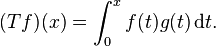
- That the
operator T is indeed compact follows from the Ascoli
theorem.
- More
generally, if Ω is any domain in Rn and
the integral kernel k : Ω × Ω
→ R is a Hilbert—Schmidt
kernel, then the operator T on L2(Ω;
R) defined by
-

- is a compact operator.
- By
Riesz's lemma, the
identity operator is a compact operator if and only if the space is
finite dimensional.
See also
Notes
-
^
N.L. Carothers, A Short Course on Banach Space Theory,
(2005) London Mathematical Society Student Texts 64,
Cambridge University Press.
-
^ William McLean, Strongly Elliptic Systems
and Boundary Integral Equations, Cambridge University Press,
2000
References
-
Conway,
John B. (1985). A course in functional analysis.
Springer-Verlag.
ISBN 3-540-96042-2
-
Renardy,
Michael and Rogers, Robert C. (2004). An introduction to partial
differential equations. Texts in Applied Mathematics 13 (Second
ed.). New York: Springer-Verlag. p. 356. ISBN
0-387-00444-0.
(Section 7.5)
-
Kutateladze, S.S. (1996). Fundamentals of Functional
Analysis. Texts in Mathematical Sciences 12 (Second ed.). New
York: Springer-Verlag. p. 292. ISBN
978-0-7923-3898-7.
from:
http://en.wikipedia.org/wiki/Compact_operator

 , and compact set
  such that
  .
. from the unit ball in X, the sequence
  contains a