787飞机的电源系统介绍
2013-03-01 10:27阅读:
Aviation pioneers
Orville
and
Wilbur Wright had a
mission: Fly forward for as long as possible, maintain speed, land
at a point at least as high as the takeoff point and carry one
pilot. In December 1903, the Wrights did just that, flying 852 feet
(260 m) in 59 seconds.
航空先驱奥赖特.威尔和
赖特.威尔伯兄弟有个任务,那就是:尽可能的飞得更远,保持一定的速度,在至少和起飞点一样高的地方着陆并且只有一名飞行员。1903年12月,赖特兄弟做到了,用59秒的时间飞到了852英尺(260米)。
Today, expectations are much higher. For example, as the world’s
most advanced family of jetliners, the 787 Dreamliner is designed
to carry as many as 290 passengers as far as 8,500 nautical miles
(15,750 km) — a third of the way around the Earth.
现在,人们的期望会更高一些。比如,作为世界上最先进家族的喷气飞机,787梦想者被设计成可搭载290名乘客,可飞行8500海里(15750公里)-即绕地球三分之一圈。
So it’s no surprise that to meet today’s missions, airplane
electrical systems have been transformed from the single electric
spark the Wright Brothers needed to the highly engineered, redun
dant systems that make modern jet travel possible.
因此,为完成今天的任务,787飞机的电源系统必须从赖特兄弟所需的单一电源发展为全新的多重系统的电源,以使现代喷气飞机远航成为可能。
The 787: A more-electric system 787-更电气化的系统
The 787 Dreamliner uses more electricity, instead of pneumatics, to
power airplane systems such as hydraulics, engine start and wing
ice protection. Benefits of the 787’s innovative, more-electric
design include:
787梦想者使用更多的电能代替气动力来给飞机系统供电,如液压、启动发动机和机翼防冰保护。得益于787飞机的更新,这个电能系统设计成包括如下功能:
More efficient power generation, distribution and use —
including new remote power distribution units, which reduce wiring
and save weight (approximately 20 miles, or 32 km, less wiring than
on the 767).
更高效的发电、
分配和利用电能-包括全新的遥控电源分配组件,这个组件减少布线并减少了飞机重量(相比767飞机减少大约20英里或32公里布线)
Better fuel efficiency — better for airlines and the
environment.
更好的燃油效率-对飞机和环境而言
Lower maintenance costs and fewer maintenance tasks.
较低的维护费用和较少的维护工作
Less drag and noise.
较少的阻力和噪音
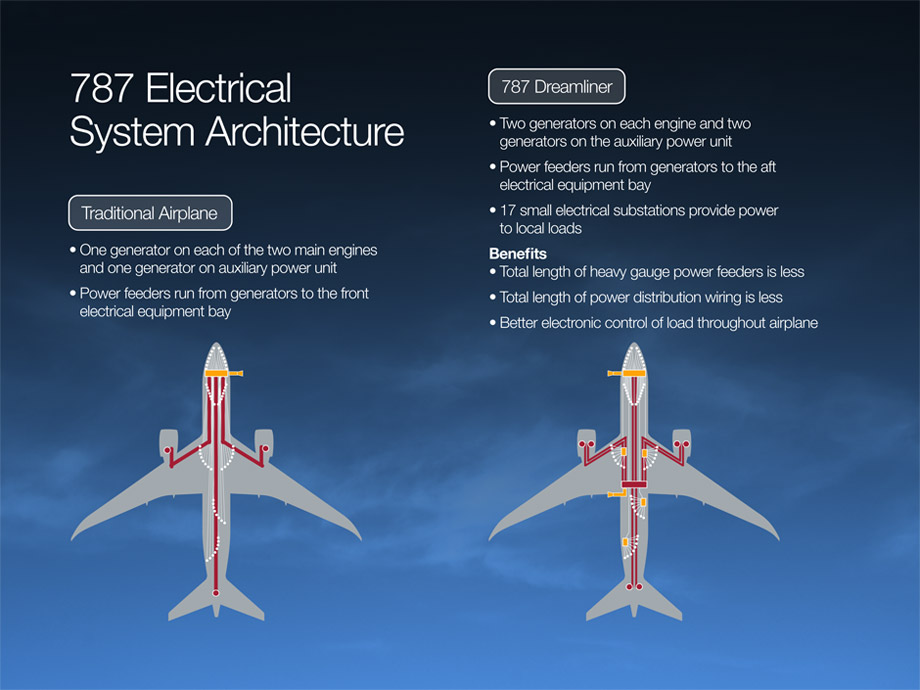
Because the 787 uses more electricity than do other Boeing
airplanes, the 787 generates more electricity, via six generators:
two on each engine and two on the auxiliary power unit (APU, a
small turbine engine in the tail).
由于787飞机比其他波音飞机使用更多的电能,因此,787飞机的需通过六个发电机发电。这六个发电包括每台发动机各两台以及两台APU发电机(APU是位于飞机尾部的一个小型的涡轮发动机)
On the ground, the 787 can be started without any ground power: The
APU battery starts the APU generators, which start the APU to power
the engine generators, which then start the engines.
在地面,787可不依赖任何地面电源进行启动。APU电瓶启动APU发电机,APU发电机启动APU,APU给发动机发电机供电,发动机发电机随后启动发动机。

In flight, the four engine generators are the primary sources of
electrical power; the APU generators are secondary. Power runs from
the generators to four alternating current (AC) buses, where it is
either distributed for use as is (235 V AC) or converted to what
other systems need.
在飞行时,四台发动机发电机是电源系统的主要电源,APU发电机是第二位的。电源从发电机传输到四个交流汇流条,以235伏交流电使用或经转换可为其他系统使用。
Other power sources for the 787 include the main battery, used
primarily for brief ground operations and braking; the APU battery,
which helps start the APU; and ground power, which can connect
through three power receptacles. The main battery, APU battery and
ram air turbine also are available as backup power in flight in the
unlikely event of a power failure.
787飞机还有其他电源包括主电瓶,主电瓶主要用于地面操作和刹车;APU电瓶用于启动APU;地面电源可通过三个电源插头连接。飞机主电瓶、APU电瓶和冲压涡轮也作为飞行中发生电源失效时的备用电源。
本文摘编自boeing.COM,转载请标明出处。