LinBoqiang:Wastenot,wantnot
2020-01-21 21:19阅读:
Waste not, want not
By Lin Boqiang | China Daily Global
Trash sorting is not an end in itself but rather a means to more
effective waste recycling and treatment
A known but poorly understood concept - garbage classification -
recently captured public attention in China as some cities have
begun to strictly implement their sorting regimes for household
waste. According to a plan issued by the Ministry of Housing and
Urban-Rural Development, all 46 major cities in China should have
their trash sorting systems in place by 2020; and all cities at or
above the prefecture level should have done so by 2025.
The amount of garbage produced has been on a rapid rise. According
to statistics, urban garbage clearance in China is 215 million
metric tons per year, 56 percent of which goes into landfills, with
only about 40 percent incinerated, recycled or reused.
Landfill uses up large amounts of land resources and poses
potential risks to the nearby environment
. Therefore, we must find appropriate ways to sort, recycle and
reutilize trash.
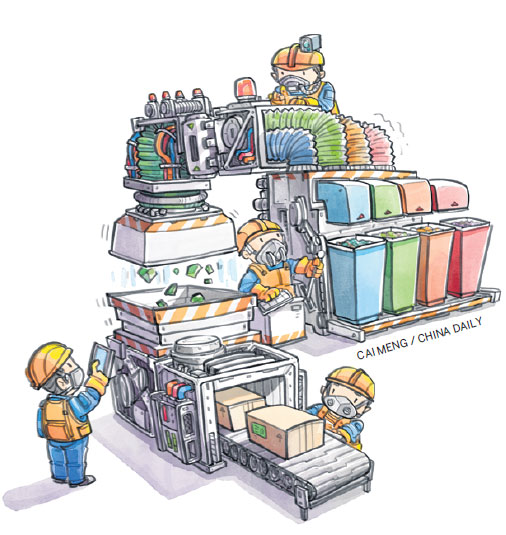
From a resource reutilization perspective, trash is nothing but a
misplaced resource. The composition of residential waste differs,
depending on lifestyles and geographical conditions. But based on
the results of a survey conducted in cities including Beijing,
Shanghai and Xi'an, kitchen waste makes up 40 to 60 percent of
residential trash, while recyclables such as paper makes up 20 to
40 percent. Due to different dietary habits, the calorific values
of kitchen waste in China is higher than the World Bank's
recommended value, making it fit for waste-to-energy applications
for power generation.
The amount of waste that is recyclable is also increasing as a
result of the ballooning packaging produced by the expanding
express delivery sector. With proper treatment, most of this can be
recycled or reutilized.
Since 2000, pilot projects in garbage classification have been put
in place in cities such as Beijing, Shanghai and Xiamen, and other
cities have also followed successively. But even though trash
sorting has been done for over 20 years, the results leave much to
be desired. This is because the implementation of the sorting
regime encounters many problems and challenges.
For instance, garbage classification calls for the participation of
many stakeholders. And as residents produce most of the household
trash, they are considered to be mainly responsible for trash
sorting.
But there are many steps involved in trash sorting, treatment and
recycling, and some sorting is best done in a centralized manner in
the later stages of the cycle. Also, garbage classification should
be done at different stages in the cycle depending on the economics
of different types of trash.
Incomplete or inadequate supporting infrastructure for trash
reutilization makes it hard to create value out of garbage
classification and may even defeat the purpose. Also, many cities
have yet to put in place a trash treatment system to make garbage
classification work as their urbanization process is incomplete. As
a result, these cities are incapable of sorting and treating
waste.
In some areas, residents sort their trash and deliver it
separately, only to see it mixed up at transfer stations or in
later stages of the process. Mishandling of this type often
discourages residents from continuing to sort their garbage.
The diversity of residents also makes it harder to coordinate trash
sorting. And even though it is beneficial for the urban environment
if residents sort their own trash, not everyone is willing to
undertake the effort. So while it is possible to use monitoring and
punitive measures to improve compliance, it will entail significant
costs.
A more effective method is to help residents develop the habit of
trash sorting through awareness of the benefits, and to punish
noncompliance so that residents will eventually want to do it
spontaneously.
Additionally, heterogeneous standards across different regions make
it difficult to scale up trash sorting and can constrain the
development of downstream industries. So, uniform standards need to
be formulated in the early stages of scaling up trash sorting in
order to enable the practice on a national scale.
Forceful administrative measures are needed in the initial stages
of running a trash sorting campaign to reverse deep-rooted habits.
How strictly trash sorting is enforced must also be compatible with
downstream trash reutilization capacity. And while it is a good
idea to take a comprehensive view of the different steps involved
in trash sorting, recycling and treatment and focus on the sorting
of hazardous waste and recyclables in particular, it is also
necessary to ramp up the trash treatment capacity to pave the way
for large-scale implementation of trash sorting.
A multistage approach to trash sorting is necessary. So while
residents can take care of the initial sorting, trash should be
further classified in the later stages of the cycle, residents
should not be burdened with the full responsibility of sorting; and
they need to be informed of the purpose of this requirement. For
that we need to build a comprehensive industry chain for trash
recycling and reutilization as fast as we can.
Strict implementation of trash sorting only makes sense when there
is a well-functioning downstream market for it. And it also needs
to be said that trash sorting has to make economic sense for the
practice to be sustainable. Otherwise sorting becomes untenable if
it is done just for the sake of sorting.
A multitude of approaches should be considered, including
financial. For example, it may be a good idea to charge a trash
collection service based on the amount, which could be an incentive
for residents to minimize their trash.
Trash sorting is an imperative. There is a plethora of best
practices and lessons from other countries that we can learn from.
And in light of these experiences and the situation at home, we can
develop reasonable and effective measures with full consideration
that trash sorting is not an end in itself, but rather a means to
more effective trash recycling and treatment.
The author is director of the China Institute for Studies in Energy
Policy at Xiamen University. The author contributed this article to
China Watch, a think tank powered by China Daily. The views do not
necessarily reflect those of China Daily.
(China Daily Global 07/24/2019 page13)

