
LinBoqiang:Poweringuprenewables
2020-01-21 21:21阅读:
Powering up renewables
By Lin Boqiang | China Daily Global
Developing countries can learn from China's successful experience
in promoting new energy
China has taken giant strides in renewable energy development and
this has given it a shining business card. Starting from scratch,
it has made great efforts to develop its new energy industry over
the past 10 years, and it is now leading the wave of energy
transformation, attracting worldwide attention.
China's new energy development is unparalleled. Consider this: In
2011, China's installed wind power capacity was 46 gigawatts and
its installed photovoltaic capacity only 2 GW. The same year,
Germany, the then world leader in renewable energy, had 29 GW of
installed wind power capacity and 24 GW of installed PV capacity.
By 2018, China's installed wind power capacity had increased to 221
GW and its installed PV capacity was about 176.1 GW, while Germany
had about 59.3 GW installed wind power capacity and
45.4GW PV capacity. In the first half of 2019, the power generated
by wind and photovoltaic power accounted for 16.2 percent of the
total power generation in China.
Since 2018, the government has accelerated the process of cutting
subsidies for the new energy industry. Due to the capacity that
could lead to further cost reduction, China will possibly move up
the time frame for large-scale grid parity.
But China's new energy development is based on China's actual
national conditions, and it faces several difficulties:
First, China's total energy demand is so huge that there is no
precedent in history and no experiences it can learn from.
Second, for China's new energy development to succeed, it has to
change its coal-based energy structure, increasingly severe
environmental pressures and energy hungry economic development
mode. In developed Western countries, economic development is
relatively stable and the environment has long been improved.
Therefore, traditional energy can be simply replaced with the new
energy. The Chinese economy, however, is still a large developing
country with huge inertia and it is difficult to abruptly deviate
from its original path. New energy can only partly replace
traditional energy to mitigate environmental pressures and
synergize with traditional energy to meet the expanding energy
demand.
Third, China's new energy resources (wind and solar potential) are
located far away from places with high energy demand, making it
difficult to replicate the new energy development model
successfully applied in developed countries.
Government support has played a crucial role in the rapid
development of China's new energy but it has encountered three
major problems in the process.
First is the cost issue in the early stage of development. The
Chinese government's solution was to adhere to industrial planning,
develop the basic manufacturing industry on a large scale with the
support of government policies, and achieve substantial cost
reduction through economies of scale.
The second is that the Chinese PV industry encountered foreign
market restrictions in 2012. The government launched a huge
domestic installation plan in time to check the collapse of the
photovoltaic manufacturing industry and strongly supported the
development and integration of the domestic PV industry chain,
which laid a foundation for China's leading role in the PV industry
today.
The third problem has been the curtailment of wind and PV power
generation in the past few years, a common problem encountered the
world over. Since 2015, the government has attached great
importance to the problem and rationally coordinated the
traditional power generation, the power grid, and power
consumptions to better accommodate new energy. In fact, by 2018,
this problem had been effectively alleviated.
China's new energy development has fully utilized China's
manufacturing advantages. Development of new energy, especially for
the domestic market, happened later than in developed countries.
When it started the technology was backward, subsidies relatively
low and even the development model was unclear.
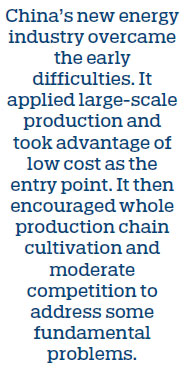
However, China's new energy industry overcame the early
difficulties. It applied large-scale production and took advantage
of low cost as the entry point. It then encouraged whole production
chain cultivation and moderate competition to address some
fundamental problems.
Taking PV as an example, China's manufacturing has reduced the cost
of PV modules by 90 percent over the past 10 years. With the
advantage of scale and cost, China's new energy industry developed
by accumulating talents and technological advantages and finally
gained market advantages. The development of China's new energy is
inseparable from the confidence in China's manufacturing. And the
amazing development speed has strengthened the confidence of the
government and industry.
China's experience can provide a development path for other
countries to learn from. The success of China's new energy industry
shows that with the right policies, developing countries with the
same environmental pressures as China can develop new energy
sources and even take advantage of being latecomers. Developed
countries, especially some European countries, have transmitted a
message to some extent in the past: New energy is a game for the
rich, and society needs to bear high subsidies in order to achieve
new energy development potential. In Germany, for example, since
the development of new energy, the average residential electricity
price has almost doubled, and its surcharge on renewable energy
power, part of the residential electricity price, has already been
more than China's average electricity tariffs. Such a development
path is unbearable and difficult for developing countries. The
success of China's relatively low-cost route has provided an
example for developing countries, especially India, which is also
facing resource constraints and environmental problems.
The author is dean of the China Institute for Studies in Energy
Policy at Xiamen University. The author contributed this article to
China Watch, a think tank powered by China Daily. The views do not
necessarily reflect those of China Daily.

(China Daily Global 08/07/2019 page13)

