程阳:National Lottery (United Kingdom) (1)
2008-08-26 02:28阅读:
程阳:National
Lottery (United Kingdom) (1)
As operator of The National Lottery, Camelot is committed to
maximising returns to the Good Causes in a socially responsible
way.
Camelot already runs the most cost-efficient lottery in Europe - an
achievement that has helped the UK National Lottery to generate
over
£22 billion for the Good Causes, and
counting.
As has always been the case, the total amount which goes to the
Good Causes depends on the mix of sales across different games and
sales channels, the level of unclaimed prizes – and the amount
raised in investment income from National Lottery balances waiting
to be allocated.
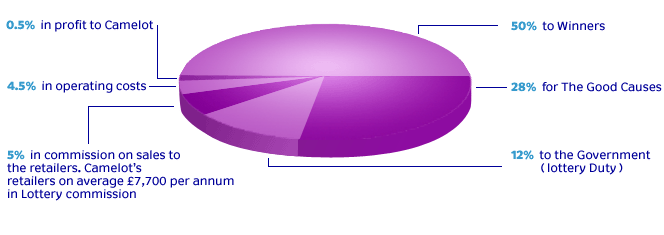
In the period up to March 2010, around 28% of total National
Lottery revenue is expected to go to the Good Causes.
During the new licence, over 50% of
total National Lottery revenue is expected to be paid to winners in
prizes, while 12% of total revenue is expected to be paid to the
Government in Lottery Duty. National Lottery retailers will earn 5%
in sales commission for each draw-based game – and 6% commission on
each Scratchcard (Camelot’s retailers earn on average
&opund;8,531 per annum in lottery commission). Operating costs
will be around 4% of total revenue.
In line with the incentivised model introduced by the NLC for the
third Licence period, the percentage of profit will be determined
by how much the operator raises for Good Causes. Depending on
performance, total profits across the course of the licence will
range from 0.3% to a maximum of 0.5% of total revenue.
Camelot is not responsible for the allocation or
distribution of lottery funds.
In the period up to March 2010, around 28% of total National
Lottery revenue is expected to go to the Good Causes. In the last
year this was distributed as follows:
- Health, Education, Environment, and charitable causes 50%
- Sports 16.67%
- Arts 16.67%
- Heritage 16.67%
Lottery Funding
The National Lottery was introduced in 1994 to raise money for good
causes.
You can access up to date information about projects and grants
funded by visiting the
National
Lottery Website.

Out of every £1 spent on the National Lottery, around 28 pence goes
to Good Causes:
- Prizes 50p
- Good causes 28p
- Treasury 12p
- Camelot (of which 0.5p is profit) 5p
- Retailers 5p.

In the last year, this 28 pence was distributed as follows:
- Health, Education, Community & Charity (the Big Lottery
Fund) 50%
- Sport 17%
- Arts 17%
- Heritage 17%.
Over £18 billion has been raised for good causes to date, with over
£28 million of this coming to South Tyneside, with projects such as
the Millennium PHAB Club, Jarrow, and South Marine Park, South
Shields, being amongst the largest of those benefiting this area.
At the other end of the spectrum, but no less important, 60 South
Tyneside Voluntary and Community Groups received Awards for All
grants of up to £5,000 last year.
 A 'play here!' sign outside a newsagent,
incorporating the National Lottery's logo of a stylised hand
with crossed fingers which
emulates a smiling face.
A 'play here!' sign outside a newsagent,
incorporating the National Lottery's logo of a stylised hand
with crossed fingers which
emulates a smiling face.
The
National Lottery is the
United Kingdom's
largest
lottery and a
Non-Departmental
Public Body. It is operated by
Camelot Group, to whom the
licence was granted in 1994, 2001 and again in 2007. The lottery is
regulated by The National Lottery Commission. The National Lottery
undertook a major rebranding programme in 2002 designed to combat
falling sales. This resulted in the main game being renamed
Lotto. However, the games as a collective are still known as
The National Lottery. It is one of the most popular forms of
gambling
in the United Kingdom.
All prizes are paid as a lump sum and are tax-free. Of every
pound (£) spent
on Lottery games, 50 pence (p) goes to the prize fund, 28p to 'good
causes' as set out by
Parliament (though
some of this is considered by some to be a
stealth
tax[1]
levied to support the New Opportunities fund, a fund constituted to
support public spending
[2]),
12p to the
British
Government as duty and 5p to retailers as commission, while
Camelot receives 4.5p to cover operating costs and 0.5p profit
[1]. Players must be at least 16 years of age to
participate in the lottery, either in the drawn lottery games or by
purchase of lottery scratch cards.
There are twelve different machines that can be used for the Lotto
draw. The machine and set of lottery balls to be used is selected
at random, and is announced just prior to the draw. The machines
are designated Merlin, Arthur, Galahad, Vyvyan, Lancelot, Garnet,
Topaz, Opal, Amethyst, Moonstone, Pearl and Sapphire. Guinevere has
also been a designated machine in the past but has now been
retired. Ball sets, of which there are eight, are designated by
number.
Contents


